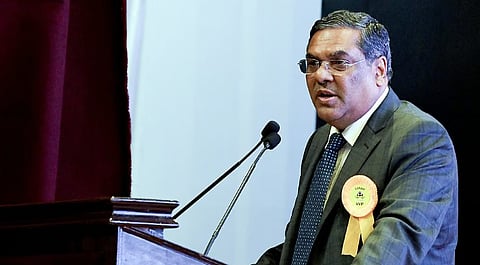

NEW DELHI: Former Chief Justice of India (CJI), Sanjiv Khanna, on Saturday said there is a prevailing perception that law enforcement agencies exist to harass rather than help, and this fear prevents people from approaching them, allowing cybercriminals to exploit the situation and harass individuals digitally.
“Instead of seeking justice, many end up paying the harassers out of fear,” he said, adding that “it’s time law enforcement became more approachable and public awareness increased, a two-way process that can truly help address the issue," the former CJI Khanna said, while addressing at the Terapanth- Dayitva: National Legal Conference on Combating White-Collar Crime, organised by the Terapanth Professional Forum (TPF) at Bharat Mandapam, New Delhi.
He described white-collar crime as “an evolving threat that corrodes the moral fabric of society” and called for greater sensitivity in applying financial laws. “Every act or failure to act that has financial implications cannot be painted with the same brush,” he said, urging lawmakers to distinguish between international fraud, unintentional error, and procedural lapse.
He added that “the strength of the justice system lies not in the severity of punishment but in the certainty of justice.”
Highlighting the need to strengthen the enforcement framework to combat white collar crime, former Director of Enforcement Directorate (ED), Karnal Singh, said that India urgently needs to adopt a "lead agency" concept to harmonise investigations conducted by multiple enforcement bodies.
He observed that lack of coordination among agencies often weakens the fight against complex financial offences. “Often, there is little cooperation among investigative bodies probing the same case. Agencies are reluctant to share evidence or documents seized during investigation,” he added, noting that this results in duplication of effort and incomplete prosecution.
Citing the AgustaWestland bribery case as an example, Singh pointed out that the trail of bribe money moved across several countries, but only a small portion that entered India was attached.
“There is no clear information about the rest of the funds,” he said, reiterating the need for Inter-agency coordination and international cooperation to effectively trace and recover illicit assets.
Ashish Kumar Chauhan, Managing Director and CEO of the National Stock Exchange (NSE), observed that as societies become more prosperous, “crimes turn more white.”
Citing a senior judge’s observation, he noted that the ratio of violent to commercial crimes had reversed over two decades, from 80 per cent physical offences to 80 per cent financial or cybercrimes.
“Today, money is no longer stolen from pockets but from systems. UPI may have removed cash, but not corruption. It has only made the thefts digital,” he remarked.
