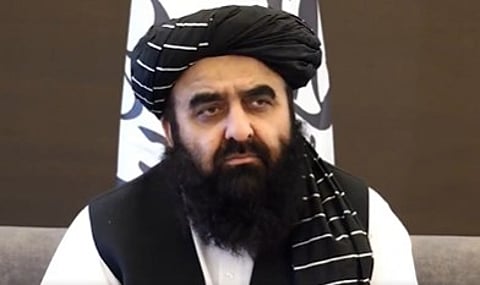

NEW DELHI: Afghanistan’s Taliban Foreign Minister Amir Khan Muttaqi, speaking from Indian soil during a six-day visit to New Delhi, issued one of his strongest warnings yet to Pakistan on Sunday, declaring that Kabul “had other options” if Islamabad refuses diplomacy. His remarks came amid sharp border clashes and growing hostility between the two neighbours following a recent Pakistani air strike in Kabul.
“The people of Pakistan, in the majority, are peace-loving … We have no issues with Pakistani civilians,” Muttaqi said during a press conference in New Delhi. However, he accused “certain sections” in Pakistan of deliberately trying to “spoil” bilateral relations.
“Afghanistan will safeguard its borders and its national interest,” he declared, adding that Kabul had already retaliated over perceived border violations. “We achieved our military objectives last night,” he said, before claiming that he had heeded calls from Saudi Arabia and Qatar to pause further escalation.
Muttaqi said, “The policy of the Islamic Emirate of Afghanistan is to resolve all problems through discussion and understanding. We want to have zero tension and if they don’t want that, then Afghanistan has other means.” He added that Afghanistan has no problem with the people and politicians of Pakistan but alleged that “certain elements” in that country are trying to “spoil the environment.”
The Taliban claimed to have killed 58 Pakistani soldiers and seized 20 border posts in retaliatory strikes, accusing Pakistan of repeated territorial and airspace violations. Islamabad disputed the claim, acknowledging 23 deaths and asserting that it had “neutralised” nearly 200 Taliban fighters in its counteroffensive. Pakistan’s Interior Minister Mohsin Naqvi denounced the Taliban’s actions as unprovoked violence against civilians, vowing retaliation “with a stone for every brick.”
“The policy of the Islamic Emirate is to resolve all problems through discussion and understanding,” Muttaqi reiterated. “Afghanistan will maintain the security of its territory and airspace. There have been violations, and we have given immediate responses to them. In the night, there were retaliatory operations in which we achieved our objectives.”
He further stated that Afghanistan has the capacity to defend its territory and airspace, adding that Kabul wants to peacefully resolve all issues through dialogue and understanding. “If some people don’t want to resolve this episode, Afghanistan has the capacity to protect its territory and airspace. The people and forces of Afghanistan are united to defend the country,” he said.
“Afghanistan has another great speciality — that even if we have internal differences, when the issue of external interference comes up, then all the Afghan people, government, and clerics get united to confront it and defend the country,” he said. “Even in the future, our people and the government will unite and defend the country,” he added.
He noted that several friendly countries, including Qatar and Saudi Arabia, had contacted Kabul and conveyed that the fighting should stop. “From our side, we have stopped the fighting, and the situation is under control. We want good relations. Our doors for talks are open. We brought peace to Afghanistan. We want peace in the entire region,” he said.
Muttaqi also cited Afghanistan’s recent history to assert that the country is determined to defeat external forces. “We have a policy of desiring good relations with all countries. There was fighting in Afghanistan for more than 40 years. The Soviet Union came and was defeated. The troops of more than 50 countries came with the US and NATO and there was fighting for 20 years, and now Afghanistan is independent and standing on its own feet,” he said.
“There have been no bad incidents in Afghanistan for four years. From East to West and North to West, people are united and standing with the Islamic Emirate,” he said.
Kabul’s warning follows recent attacks along the Durand Line that have deepened the humanitarian stress in landlocked Afghanistan. The closure of the Torkham and Chaman crossings has stranded trade caravans on both sides, worsening the crisis.
Muttaqi’s visit to New Delhi is being closely watched as a signal in the regional diplomatic landscape. Without explicitly recognising the Taliban regime, India has upgraded its technical mission in Kabul to a full embassy — a significant step that underscores New Delhi’s willingness to engage directly with Kabul’s new rulers. Against that backdrop, Muttaqi’s pointed remarks from a high-profile Indian stage carry considerable diplomatic weight.
His comments also diverge from earlier Taliban postures that avoided public confrontation with Pakistan. Now, Kabul is explicitly calling out alleged cross-border aggression. “Don’t provoke Afghanistan too much — if you do, ask the British, the Americans … playing such games with Afghanistan,” Muttaqi warned during a press conference on Friday in Delhi.
Muttaqi reiterated Kabul’s preference for diplomacy: “We want good relations and peace. If Pakistan doesn’t want that, we have other options.” He cast Afghanistan’s defiance as a defensive posture born of four decades of invasion and conflict.
Islamabad, however, did not receive the remarks quietly. Pakistan’s Foreign Office countered that Kabul’s deflections on alleged cross-border terrorism would not absolve it of regional obligations, and also objected to a reference in the India-Afghanistan joint statement to Jammu and Kashmir as part of India.
(Inputs from PTI)