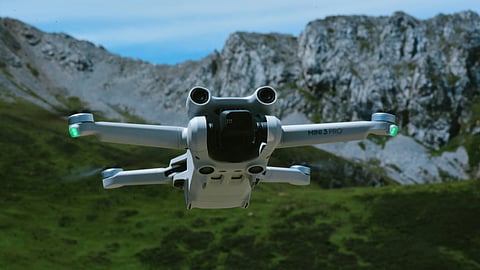

NEW DELHI: The first-ever tri-services military exercise held to simulate aerial threats and defense responses turned out to be a major display of indigenous capabilities.
"The drones, unmanned aerial vehicles, and the defense responses, including counter-drone and jamming equipment have been largely produced in India," sources said.
The exercise aimed to bring together all stakeholders, the Army, Navy, and Air Force, to simulate all possible scenarios and employ their countermeasures "to stay ahead of adversaries, drawing lessons from Operation Sindoor," the source added.
Operation Sindoor, launched in May to destroy terrorist infrastructure in Pakistan and Pakistan-occupied Jammu and Kashmir, saw major deployment of drones by both the Indian and Pakistani armed forces.
In a short span of time, drones have become an integral part of the military as they minimize danger to human life, are cost-effective, and deliver high-impact results, the source noted, adding that this capability will continue to mature.
While drone technology continues to expand, the exercise will also aid in formulating a drone doctrine, the source added.
Exercise Cold Start, conducted by the Headquarters Integrated Defence Staff (HQ-IDS), showcased seamless synergy between the Ministry of Defence, Indian Armed Forces, DRDO, and civil partners.
According to HQ-IDS, "The exercise integrates cutting-edge counter-UAS, surveillance, and electronic warfare systems, creating an impenetrable shield against evolving aerial threats."
"Through real-time coordination and technology-driven tactics, the tri-services demonstrated unmatched capability to detect, track, and neutralize drones, loitering munitions, and RPAs in a high-intensity simulated combat environment, reaffirming India's resolve towards jointness, integration, and a future-ready force."
Cold Start, HQ-IDS added, underscores India’s growing emphasis on technological innovation, interoperability, and tri-service operational synergy, reinforcing the nation's preparedness to safeguard its skies and sovereignty in the era of hybrid warfare.
While joint training strengthens coordination among the armed forces in counter-drone warfare, the exercise also served as a "demonstration of preparedness and new technological inductions."
As previously explained by The New Indian Express (TNIE), jointness and integration are the cornerstones of the transformation toward joint structures, a direction in which the Indian Armed Forces are progressing with the goal of becoming "future-ready." The year 2025 is being observed as the 'Year of Reforms' in the Ministry of Defence (MoD).
Under the MoD’s Department of Military Affairs (DMA), HQ-IDS functions as the nodal organization for jointmanship within the Ministry of Defence. It integrates policy, doctrine, warfighting, and procurement of arms and equipment.
The induction of unmanned aerial vehicles has been described as a revolution in military affairs, prompting major shifts in tactics, strategy, and the employment of arms and equipment.
