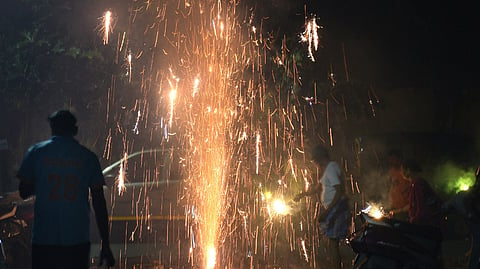

NEW DELHI: As India gears up for Diwali celebrations, green crackers have emerged as a cleaner alternative to traditional firecrackers, aiming to reduce environmental and health impacts.
Developed by the Council of Scientific and Industrial Research, National Environmental Engineering Research Institute (CSIR-NEERI), these eco-friendly crackers are engineered to emit fewer pollutants while maintaining similar sound and visual effects.
Green crackers reduce emissions of harmful substances such as barium, sulfur dioxide, and nitrogen dioxide by 30 to 60 percent. This is achieved through modified chemical compositions that include additives like zeolite and iron oxide. These bind with fine particulate matter such as PM10 and PM2.5, forming heavier compounds that settle more quickly, thus limiting air dispersion. Additionally, smaller shell sizes and optimized formulations result in lower raw material consumption and controlled noise levels, keeping sound emissions below 125 decibels in compliance with environmental standards.
To ensure authenticity and quality control, certified green crackers are embedded with QR codes. This system, developed to curb counterfeit products, allows users to verify the legitimacy of their purchases and encourages adherence to approved safety standards.
The adoption of green crackers marks a gradual transformation within India’s Rs 6,000 crore firecracker industry, long dominated by conventional products. While traditional firecrackers still account for an estimated 70,000 to 80,000 tonnes in annual sales, their market share is shrinking by 10 to 15 percent each year. In contrast, green cracker sales are on the rise, growing approximately 20 percent annually to reach 20,000–25,000 tonnes, with a turnover estimated between Rs 1,800 and Rs 2,000 crore. Most licensed production remains centered in Sivakasi, Tamil Nadu, where manufacturers follow CSIR-NEERI’s approved formulations and guidelines.
The growing demand for green crackers is partly supported by legal clarity. The Supreme Court recently permitted the sale and regulated use of certified green firecrackers in Delhi and the National Capital Region (NCR) during Diwali. As per the court's order, bursting is allowed only during specified time slots, 6–7 a.m. and 8–10 p.m on the day before and the day of the festival. Only crackers bearing official QR codes are permitted at designated locations.
Despite these measures, Delhi continues to experience dangerous spikes in air pollution during the festive season. In November 2024, the city’s Air Quality Index (AQI) crossed 1,500—categorized as hazardous—placing it among the most polluted cities in the world. In response, the Delhi Pollution Control Committee reiterated the permanent ban on conventional firecrackers under Section 5 of the Environment (Protection) Act, 1986, and issued public notices encouraging citizens to report any illegal sale, storage, or usage.
As India navigates the balance between cultural tradition and environmental responsibility, green crackers represent a step toward cleaner celebrations, though challenges in enforcement and awareness persist.
