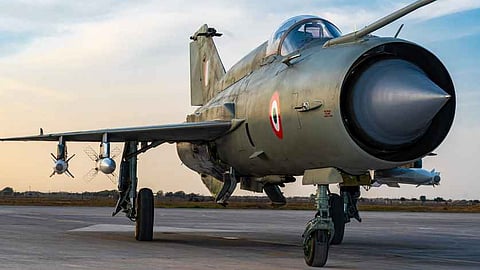

NEW DELHI: As the historic MiG-21 combat fighters prepare to retire from service, government and academic institutions are lining up to request the airframes for display. The final squadron of MiG aircraft is set to bid farewell on 26 September at Chandigarh.
An Indian Air Force (IAF) source said, "There is a waitlist of applications from government, academic, public, and private institutions requesting old MiG-21 aircraft."
The waitlist spans five to six years once applications are received by IAF Headquarters, the source added.
A procedure is followed for retired aircraft, either putting them up for salvage or transferring them to requesting institutions. In the case of salvage, parts that can be reused are removed, and the remaining components are scrapped.
For transfer, the airframe is provided without the engine and related systems. Government institutions require paperwork before the transfer, while private institutions must bear a cost of Rs 30–40 lakh. The maintenance of the airframe is the responsibility of the receiving institution.
Applications to request a retired aircraft involve approval from the local municipal office before the IAF takes a decision. If maintained by the IAF’s Repair and Salvage Unit (RSU), the airframe undergoes annual maintenance, including painting, repair, and beautification routines.
The MiG-21 jets were first inducted into the IAF in 1963 as high-altitude interceptors and were later adapted for ground-attack roles. The aircraft were originally designed in the USSR to counter American U-2 spy planes.
A ceremony marking the final flight of the Number 23 Squadron MiG-21s will be attended by a large number of air force personnel at the end of this month.
The first induction of the Russian-origin single-engine MiG-21 fighters took place in 1963, with different versions joining the IAF over the years. Currently, the IAF operates one squadron of MiG-21 Bison at Suratgarh, with each squadron comprising 16–18 aircraft.
As previously reported by the TNIE, the IAF has operated 24 fighter squadrons and four training units of MiG-21s, flying over 850 aircraft across six decades, a scale unmatched by most air forces.
