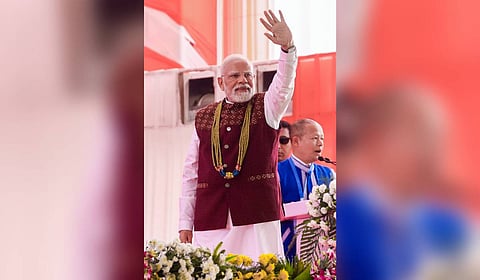

GUWAHATI: Prime Minister Narendra Modi on Monday hailed the next-generation GST reforms, stating that the benefits will significantly impact the lives of people. PM slammed the Congress for ignoring the Northeast when it was in power.
Addressing a crowd in Arunachal Pradesh's capital, Itanagar, after laying the foundation stone and inaugurating various development works worth over Rs 5,100 crore, Modi said families would now experience substantial relief in their monthly budgets.
“Essential items, such as kitchen supplies, educational materials for children, and footwear and clothing, have become more affordable,” he said.
The PM said that despite facing major challenges over the years, his government consistently reduced income tax rates. He announced that GST had been simplified to just two slabs—5 per cent and 18 per cent. He emphasised that many items have become tax-free, and taxes on other goods have been significantly reduced.
He highlighted that building a home, purchasing a scooter or bike, dining out, and travelling have all become more affordable. He affirmed that the GST 'Savings Festival' would be a memorable milestone for the people.
The PM criticised the Congress for its “longstanding tendency” to avoid difficult development tasks, stating that it adversely impacted Arunachal and the rest of the Northeast.
He said challenging terrains—mountainous regions, forested areas—were often declared backwards and neglected by the Congress, and the tribal regions and districts in the Northeast suffered the most.
He said the Congress had dismissed the villages near the international border as “last villages” to evade responsibility and conceal its failures. He said this neglect led to continuous migration from tribal and border areas.
The PM said the BJP-led government at the Centre transformed the earlier approach towards regional development. He mentioned that districts previously labelled as “backward” had been redefined as “aspirational districts” and prioritised for growth.
Border villages once dismissed as “last villages” have now been recognised as the nation’s “first villages,” Modi said, highlighting the positive outcomes of this shift, such as the accelerated pace of development in border areas.
He said the success of the “Vibrant Villages Programme” had significantly improved the quality of life.
In Arunachal, he said, over 450 border villages have witnessed rapid progress, with essential infrastructure like roads, electricity, and internet now reaching these regions. While migration from border areas to cities was once common, these villages are now emerging as new hubs of tourism, he added.
He expressed satisfaction that the number of tourists visiting Arunachal has doubled over the past decade. He emphasised that Arunachal’s tourism strength goes beyond nature and culture, pointing to the global rise of conference and concert tourism.
In this context, he announced that the upcoming modern convention centre in Tawang will add a new dimension to the state’s tourism landscape.