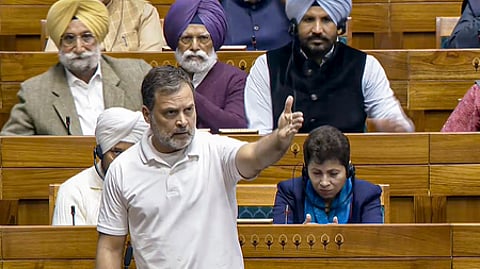

Amid a controversy over Congress leader Rahul Gandhi quoting from an unpublished memoir of former Army chief M.M. Naravane in the Lok Sabha, an expert on parliamentary procedure has said that Rule 349, cited by the Speaker to disallow the reference, does not distinguish between published and unpublished material.
Former Lok Sabha Secretary-General P.D.T. Achary told PTI on Tuesday that Rule 349, which sets out “rules to be observed by members in the House”, bars members from reading any book, newspaper or letter except in connection with the business of the House. The rule, however, is silent on whether the material must be published.
While the provision is “negatively framed”, Achary said it also carries a “positive meaning”, allowing members to refer to documents if they are relevant to the business under discussion.
On Monday, the Lok Sabha was debating the Motion of Thanks on the President’s Address, which could legitimately touch upon foreign policy and national security issues, he noted.
The Lok Sabha witnessed repeated adjournments on Monday after Speaker Om Birla disallowed Gandhi, the Leader of the Opposition, from quoting from the former Army chief’s unpublished memoir on the 2020 India-China standoff, citing Rule 349.
Defence Minister Rajnath Singh objected to the reference, questioning how unpublished material could be cited in the House.

Achary pointed out that while not explicitly stated in the rules, Speakers have consistently required members to authenticate any document they quote.
“A member must state that they stand by the document and verify its contents. Once that is done, the Speaker allows the quotation. Thereafter, it is for the government to respond,” he said.
He cautioned that members are accountable for the accuracy of material cited in the House. Quoting from incorrect or fabricated documents could invite a privilege motion, he said.
Despite the Speaker’s ruling, Gandhi sought to quote from a media report that carried excerpts from the unpublished memoir, leading to further disruptions. The Congress leader accused the government of being “afraid” of the passage he intended to read out.
The BJP alleged that Gandhi’s remarks undermined the dignity of Parliament and hurt the morale of the armed forces. Ruling party leaders accused him of echoing “anti-India” narratives, rejecting his claims as false and misleading.
(With inputs from PTI)