
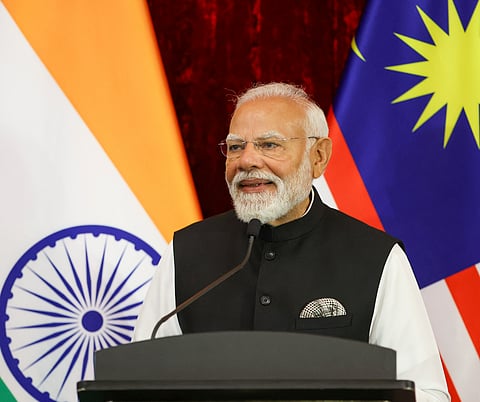
PM Modi stresses strategic trust, no double standards or compromise on terrorism

NEW DELHI: Prime Minister Narendra Modi on Sunday reiterated that India’s stance on terrorism is firm and uncompromising, while highlighting that strategic trust with Kuala Lumpur is central to economic transformation.
The joint statement issued after bilateral talks explicitly condemned cross-border terrorism, signalling both leaders’ shared commitment to tackling threats that cross national boundaries.
Speaking at the joint press briefing alongside Malaysian Prime Minister Anwar Ibrahim, Modi added, “On terrorism, our message is clear: no double standards, no compromise. In the field of security, we will strengthen cooperation in counter-terrorism, intelligence sharing, and maritime security. We will expand defence cooperation.”
“The two Prime Ministers unequivocally and strongly condemned terrorism in all its forms and manifestations, including cross-border terrorism. They called for zero tolerance of terrorism and for concerted international efforts to combat terrorism in a comprehensive and sustained manner,” the joint statement said. For India, cross-border terrorism refers to terrorism coming from Pakistan.
The leaders also outlined a broad roadmap for economic and technological collaboration. “Along with AI and digital technologies, we will further our collaboration in semiconductors, health, and food security,” Modi said. “The CEO Forum held today has opened up new opportunities for trade and investment. We will chart the way to economic transformation through strategic trust.”
A series of agreements were signed to deepen bilateral cooperation across multiple sectors, including defence and security, digital payments, social security for Indian workers, audio-visual collaboration, and tourism. Institutional initiatives included the establishment of a dedicated Thiruvalluvar Centre at Universiti Malaya in Kuala Lumpur and the launch of Thiruvalluvar Scholarships for Malaysian nationals.
The joint statement also spelled out a detailed agenda on counter-terrorism. Both leaders agreed to counter radicalisation and violent extremism, combat financing of terrorism, and prevent the misuse of emerging technologies for terrorist purposes through information sharing, exchange of best practices, and capacity-building. Recognising the linkages between terrorism and transnational organised crime, Modi and Ibrahim committed to enhanced cooperation in tackling organised crime through intelligence sharing and mutual expertise. They reaffirmed their commitment to strengthen bilateral and multilateral efforts, including within the UN and FATF frameworks.
The mention of cross-border terrorism in the statement signals India’s concern over threats emanating from across its borders while reflecting Malaysia’s growing understanding with India’s counter-terrorism priorities.
Modi’s visit comes amid ongoing diplomatic engagement over the extradition of fugitive preacher Zakir Naik, which was expected to figure among discussions with Kuala Lumpur.
On the regional and strategic front, Modi highlighted the significance of the Indo-Pacific and said "The Indo-Pacific region is emerging as the growth engine of the world.” Ibrahim emphasised the steady expansion of India-Malaysia cooperation in trade, investment, connectivity, and defence, noting, “India’s rise on the global trade and economic front has provided new momentum for Malaysia-India cooperation.”