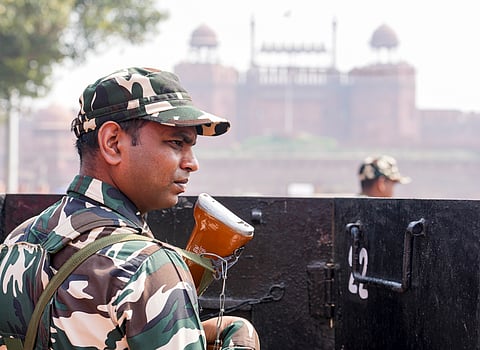

The Special Cell of Delhi Police has arrested eight persons and dismantled a Bangladeshi module of highly radicalised individuals affiliated with Lashkar-e-Toiba, following coordinated raids in the national capital, Kolkata and Tamil Nadu. Police said the timely action averted possible terror strikes in India.
Of the eight arrested, seven are Bangladeshi nationals who had illegally entered India and procured Indian identity documents to conceal their nationality. Investigators said the module was recruited, indoctrinated and handled by a trained Kashmiri LeT handler operating from Bangladesh.
The module’s main handler has been identified as Shabir Ahmad Lone, a resident of Srinagar, who is currently based in Bangladesh. Lone was earlier arrested by the Special Cell in 2007 in a terror case involving the recovery of arms and ammunition, including an AK-47 rifle and grenades. He remained lodged in Tihar Jail till 2018 before fleeing to Bangladesh, where he revived LeT networks in India and reactivated sleeper cells of Bangladeshi operatives.
The arrested accused have been identified as Umar Faruk (31), stated to be a resident of West Bengal; Robiul Islam (31); Mohammad Mizanur Rehman (32); Mohammad Sefayat Hossain (34); Mohammad Zahidul Islam (40); Mohammad Liton (40); Mohammad Uzzal (27); and Umar (32), all residents of Bangladesh. According to the police, the group was planning to target areas with heavy public footfall.
The case came to light on February 8 after a written complaint was submitted by a CISF shift in-charge at the Supreme Court Metro police station regarding pro-Pakistan and pro-terror posters being affixed by unknown persons at the Janpath Metro Station. During inquiry, similar posters were found at several other locations in Delhi.
Police said the posters carried photographs glorifying slain Burhan Wani of Jaish-e-Mohammad and other militants. One of the posters read “India stop genocide & Free Kashmir”, along with Urdu slogans translating to “Hum Pakistani Hain, Pakistan Hamara Hai” and “Kashmiri Ek Jut-ta Divas”, Additional Commissioner of Police (Special Cell) Pramod Singh Kushwah said.
An FIR was registered at the Supreme Court Metro police station and the investigation was transferred to the Special Cell. Investigators traced the initial leads, which were subsequently developed into actionable operational intelligence.
The Special Cell had already been gathering inputs on LeT operatives and their Bangladeshi linkages in the wake of recent developments in Bangladesh. Based on technical analysis and manual verification, the movement of suspects was tracked in Delhi and Gurugram, eventually leading investigators to Kolkata.
On February 15, the hideout of the Kolkata module was identified at Majherpara in Hatiara Gote area, following which a raid was conducted and Umar and Robiul Islam were arrested. Subsequently, on February 21, hideouts of the Tamil Nadu module were identified, and six cadres were arrested from Tiruppur in simultaneous raids.
During searches, multiple pro-Pakistan and pro-terror posters were recovered from the rented accommodations of the accused. Police also found posters affixed at several locations in West Bengal. Ten mobile phones containing incriminating material, 25 credit and debit cards, five POS machines, Bangladeshi passports and identity cards were seized.
During interrogation, Faruk revealed that he came in contact with Lone in March 2025 and was gradually indoctrinated. Lone later appointed Faruk to spearhead LeT operations in India, with a plan to use Bangladeshi nationals posing as Indian citizens to carry out terror attacks.
In December 2025, Lone directed Faruk to conduct reconnaissance of important locations across the country and to send videos after the recce. Following the reconnaissance, Faruk was instructed to visit Lone in Bangladesh for further directions and was tasked with recruiting more Bangladeshi nationals illegally residing in India.
As per Lone’s instructions, Faruk rented a hideout in Kolkata and shared its details with him. The premises were meant to serve as both a safe house and a base for terror activities. Lone also directed Faruk to arrange weapons, following which Faruk began contacting local sources.
On February 6, Faruk and Robiul Islam travelled from Kolkata to Delhi via Patna. During the night of February 7, they affixed pro-Pakistan and pro-terror posters at 10 locations in Delhi, filmed the act and sent the videos to Lone, before returning to Kolkata by train the next day. Lone later congratulated them and instructed them to carry out similar activities in Kolkata as well.
Police said Lone was assisted by another accomplice, Saidul Islam, a Bangladeshi national currently believed to be in a foreign country. Saidul allegedly facilitated Lone’s illegal entry into Bangladesh, arranged his hideout there, and also provided details of the Tamil Nadu-based LeT operatives to Lone and Faruk.
Faruk and Robiul Islam subsequently affixed posters at multiple locations in Kolkata, recorded videos and shared them with Lone. Investigators said Lone was actively planning terror incidents in India using Bangladeshi nationals.
Police further stated that Lone had direct links with LeT’s top leadership, including Hafiz Saeed and his deputy Zaki Ur Rehman Lakhvi, at the time of his arrest in 2007. A trained militant of LeT, Lone underwent Daura-e-Aam (basic training) and Daura-e-Khaas (advanced training) at the Muzaffarabad LeT camp.
He is allegedly backed and funded by Inter-Services Intelligence to recruit Bangladeshi youth illegally residing in India for planning and executing terror plots, police said.