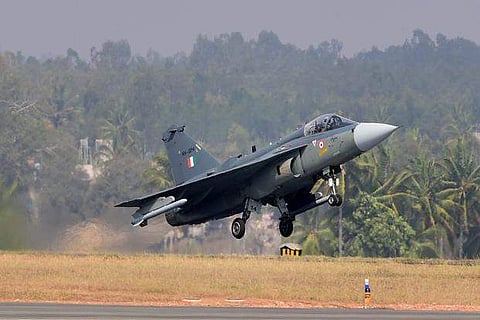

NEW DELHI: The Indian Air Force (IAF) has grounded its entire Tejas fleet as a precautionary measure following a runway incident earlier this month, even as Hindustan Aeronautics Limited (HAL) on Monday described the episode as a “minor technical incident”.
According to defence sources, the IAF has initiated a comprehensive technical review across critical systems to determine the cause of the incident. There has been no official statement from the IAF so far on either the incident or the temporary grounding and it remains unclear whether the airframe involved will be written off.
It is learnt that the grounding comes after an incident in early February at Naliya Air Base in Gujarat, where a Tejas MK1 overshot the runway during takeoff. Sources said the jet slid into a nearby mud patch softened by prior rainfall while in the acceleration phase of takeoff. The pilot sustained injuries in the incident but is reported to be safe.
Hindustan Aeronautics Limited (HAL) on Monday issued a clarification to SEBI, refuting reports of the crash and stating that there had been no incident involving the LCA Tejas beyond a “minor technical issue” on the ground. The company further added that Tejas MK1 continues to maintain one of the world’s best safety records among contemporary fighter aircraft.
However, if the crash is confirmed, this would mark the third loss involving the Tejas MK1. The first loss of a series-production jet occurred in March 2024, when a fighter crashed near Jaisalmer, Rajasthan, shortly after participating in the tri-services exercise Bharat Shakti. The second incident took place in November last year at the Dubai Airshow, where Wing Commander Namansh Syal was killed while performing an aerobatic display.
HAL is yet to complete delivery of the IAF’s Tejas Mk-1 order. Of the 40 aircraft contracted, comprising 16 IOC single-seaters, 16 FOC single-seaters and eight twin-seat trainers, only 38 have been delivered so far, with the two remaining FOC trainer variants still pending.
The delays extend to the larger Tejas Mk-1A programme as well, where deliveries of 180 aircraft are running over two years behind schedule, with timelines repeatedly slipping and being revised.
