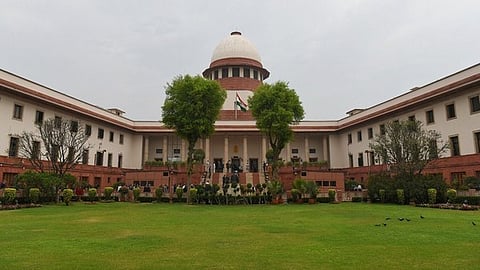

NEW DELHI: The Supreme Court has recently in its order held that it is constitutionally impermissible for anybody, be it the State or non-state actors, through any medium, such as speeches, memes, cartoons, visual arts etc to vilify and denigrate any community.
"It will be violative of the Constitution to target any particular community on the basis of religion, language, caste or region by whosoever he or she may be. This is particularly true for public figures occupying high constitutional office who have taken the solemn oath to uphold the Constitution,'' said Justice Ujjal Bhuyan.
He made the observations in his separate order in the petition filed by Atul Mishra, the National Organisation Secretary of the Brahman Samaj of India, through advocate Dr Vinod Kumar Tewari, challenging the Netflix film's title Ghooskhor Pandat.
The plea has sought directions to ban the film from being released or screened in its current form.
The other judge in the apex court, Justice B V Nagarathna, leading the bench, closed the case after the film makers agreed to change the title.
Justice Bhuyan in his separate order cited Imran Pratapgarhi case, in which a two-judge bench had said, ''75 years into our republic, we cannot be seen to be so shaky on our fundamentals that mere recital of a poem or for that matter, any form of art or entertainment, such as, stand-up comedy, can be alleged to lead to animosity or hatred amongst different communities. Subscribing to such a view would stifle all legitimate expressions of view in the public domain which is so fundamental to a free society.''
Justice Bhuyan added that the Courts are duty-bound to uphold and enforce fundamental rights guaranteed under the Constitution of India. "Sometimes, we, the Judges, may not like spoken or written words. But, still, it is our duty to uphold the fundamental right under Article 19(1)(a). We Judges are also under an obligation to uphold the Constitution and respect its ideals. If the police or executive fail to honour and protect the fundamental rights guaranteed under Article 19(1)(a) of the Constitution, it is the duty of the Courts to step in and protect the fundamental rights. There is no other institution which can uphold the fundamental rights of the citizens," he stressed.
Justice Bhuyan further highlighted in his separate order that Courts, particularly the Constitutional Courts, must be at the forefront to zealously protect the fundamental rights of the citizens. "It is the bounden duty of the Courts to ensure that the Constitution and the ideals of the Constitution are not trampled upon. Endeavour of the courts should always be to protect and promote the fundamental rights, including the freedom of speech and expression, which is one of the most cherished rights a citizen can have in a liberal constitutional democracy. The Courts must not be seen to regulate or stifle the freedom of speech and expression. As a matter of fact, the Courts must remain ever vigilant to thwart any attempt to undermine the Constitution and the constitutional values, including the freedom of speech and expression."
