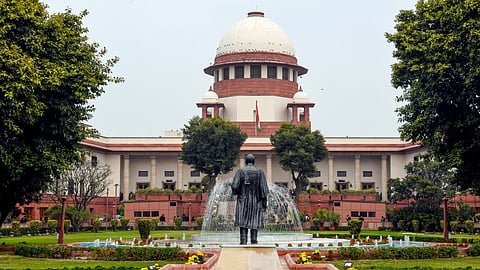

The Supreme Court of India on Thursday imposed a blanket ban on a Class 8 textbook published by the National Council of Educational Research and Training (NCERT) carrying a chapter on corruption in the judiciary, ordering the seizure of all physical copies and the immediate takedown of its digital versions.
Directing both the Centre and State authorities to comply forthwith, the court warned of “serious action” if its directions were defied in any form.
A three-judge bench of the apex court headed by the Chief Justice Surya Kant also issued show-cause notices to the NCERT Director and the School Education Secretary, asking them to explain why action should not be taken against those responsible for the inclusion of the chapter.
“It is my duty to find out who is responsible; heads must roll,” the Chief Justice remarked during the hearing. He raised serious concern over the contents of the chapter and its potential impact on public perception of the judiciary.
The Bench said it appeared to reveal a “deep-rooted, well-planned conspiracy” aimed at defaming the judiciary and weakening institutional authority.
“It seems to us that there is a calculated move to undermine the institutional authority and demean the dignity of the judiciary. If allowed to go unchecked, this will erode the sanctity of judicial office in the estimation of the public at large and within the impressionable minds of youth,” the Chief Justice observed, according to Bar and Bench.
The court added that no individual or authority involved would be allowed to “go scot-free.”
Meanwhile, Solicitor General Tushar Mehta tendered an unconditional and unqualified apology on behalf of the Ministry of Education. However, the Bench noted that NCERT’s official communication contained no explicit apology and instead appeared to justify the inclusion of the material.
The Bench also said it was inclined to order a deeper probe to identify those responsible for approving and publishing the chapter.
The proceedings arose from the court’s suo motu cognisance of the textbook chapter discussing corruption within the judiciary, which drew criticism for allegedly presenting institutions in a manner viewed as prejudicial and misleading for school students.
The NCERT Class 8 social science textbook chapter "The Role of the Judiciary in Our Society" highlights key challenges facing India’s judicial system, including corruption, a massive backlog of cases, and a shortage of judges. According to the chapter, around 81,000 cases are pending in the Supreme Court, 62.4 lakh in high courts, and 4.7 crore in district and subordinate courts.
The book also refered to internal accountability mechanisms within the judiciary and mentions the Centralised Public Grievance Redress and Monitoring System (CPGRAMS) as a channel for complaints. According to the text, more than 1,600 complaints were received through this mechanism between 2017 and 2021.
It further quoted former Chief Justice of India B R Gavai, who in July 2025 said instances of corruption and misconduct within the judiciary had adversely affected public confidence. “However, the path to rebuilding this trust lies in the swift, decisive and transparent action taken to address and resolve these issues... Transparency and accountability are democratic virtues,” he is quoted as saying.
(With inputs from Suchitra Kalyan Mohanty)
