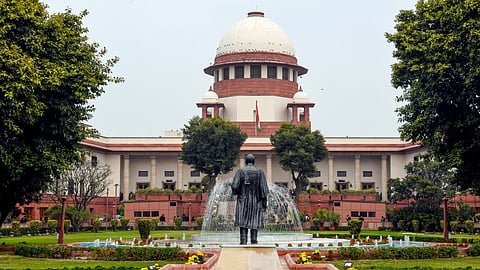

The Supreme Court on Thursday said it will first seek the opinion of experts on whether mining can be permitted in the Aravalli region and, if so, to what extent.
SC extended the stay of the operation of its earlier November 20 verdict on all the licensed mining activities for the time being.
The top court bench took suo motu proceedings -- of the definition of Aravalli -- on December 29, after serious concerns were raised that the revised definition of the Aravalli Hills could permit unregulated mining which could have a devastating effect to the environment.
While continuing and extending the status quo order on all licensed mining activities for the time being, a three-judge bench of the apex court, headed by the Chief Justice of India (CJI) Surya Kant and Justices Joymalya Bagchi and Justice Vipul M Pancholi, requested the Ministry to suggest a panel of domain experts (on mining issues) along with their profiles.
"The opinion of the Ministry of Environment, Forest and Climate Change would be of assistance in defining the expression Aravalli, its total area, the ranges, the forest cover, and identifying parts of the Aravalli where cities, towns and villages have already been developed over centuries," said the top court on Thursday.
It also asked the advocates appearing in the matter from all the respective parties to suggest eminent subject experts' names for constituting the committee.
Requesting Advocate Jai Cheema to assist the Court as a domain expert in the matter, the court on Thursday granted time till March 10 to advocates for the parties and intervenor to submit their respective notes on the issue.
The matter will now be listed for the purpose of constituting the committee and framing the issues that arise in the case.
The November 20 verdict -- delivered by the then CJI B R Gavai -- had restricted the definition of the Aravalli range to landforms rising at least 100 metres above the local terrain.
The court had earlier asked for names to be suggested of eminent forest experts, environmentalists etc, so that an expert body can be formed to look into all aspects and assist the court. Such a committee shall work under the direct control and supervision of this court.
Earlier on December 29, the Supreme Court had in its order, stayed the operation of its earlier November 20 verdict on the issue.
The apex court passed the order earlier, after taking suo motu cognisance of the issue and decided to take up the issue on its own.
Noting that it wanted to revisit the contentious issue surrounding the identification and protection of the Aravalli range, the top court had earlier proposed the constitution of a high-powered expert committee -- including domain specialists -- to comprehensively re-examine questions relating to the height, extent, and ecological significance of the Aravallis.
The November 20 ruling was pronounced by the top court in a suo motu matter linked to the long-running TN Godavarman Thirumulpad environmental litigation, as it accepted a ban on mining in core or inviolate areas, while restricting the mining activities as outlined by the committee and strictly following the law being followed to do so.
Amidst the severe apprehension that the recent change in the definition of Aravalli may be unchecked and lead to unregulated and illegal mining, the Supreme Court had taken suo motu cognisance of the matter and decided to hear it.
In its judgment on November last year, the bench led by the then Chief Justice Gavai (Now retired) accepted the Ministry of Environment, Forest and Climate Change (MoEF&CC) committee's recommended operational definition for the Aravali Hills and Ranges in the context of mining.
It is to be noted that Aravalli Hills are among India’s oldest geological formations, stretching from Delhi through Haryana, Rajasthan, and into Gujarat.
Historically, they have been recognized across 37 districts by state governments, with their ecological role noted as a natural barrier against northern desertification and a protector of biodiversity and water recharge.
