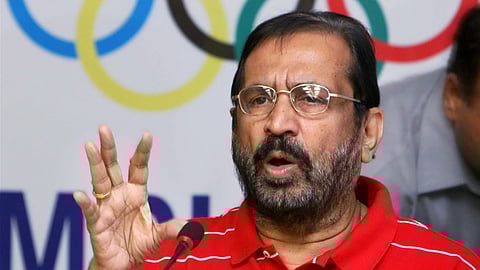

MUMBAI: Suresh Kalmadi, a resourceful yet controversial figure who spent more than two decades at the centre of Indian sports administration, has died at the age of 81.
The senior Congress leader and former Union minister passed away in Pune on Tuesday after a prolonged illness. He is survived by his wife, a son, two daughters, their spouses and grandchildren.
A former president of the Indian Olympic Association (IOA), his long tenure in Indian sport brought both notable successes and high-profile scandals.
Born in Tamil Nadu on 1 May 1944, Kalmadi was educated at Fergusson College in Pune, the city he later represented in Parliament.
Before entering the political arena, Kalmadi attended the National Defence Academy (NDA) in Khadakwasla. He then served in the Indian Air Force from 1964 to 1974: first as a commissioned pilot, then as an instructor, and retired as a Squadron Leader.
As an Indian Air Force Pilot, he participated in the 1966 air raid on Aizawl during the Mizo National Front uprising, as well as the 1965 and 1971 India–Pakistan wars. He received several service medals and took early retirement to enter politics.
Kalmadi entered politics after being identified by Sharad Pawar, serving as president of the Indian Youth Congress (Socialist) from 1981 to 1986, and later developed close political ties with Sanjay Gandhi and former Prime Minister Rajiv Gandhi. He formally entered politics in 1982 and was elected to the Rajya Sabha, backed by Congress(S) led by Sharad Pawar. He was re-elected to the Rajya Sabha in 1988, 1994 and 1998.
After the Congress split in the late 1980s, Kalmadi stayed with the Indian National Congress. During his tenure as a Rajya Sabha MP, he also served as Union Minister of State for Railways in the PV Narasimha Rao government in 1995.
Kalmadi was elected to the Lok Sabha from Pune in 1996, but lost the seat in the very next general election before making a comeback by winning the 2004 and 2009 polls.
In 1991, Sharad Pawar decided to compete with PV Narasimha Rao for the Prime Minister post, expecting support from most Congress MPs.
Kalmadi was entrusted with the responsibility of reaching out to Congress MPs and powerbrokers. Kalmadi arranged a dinner party in Delhi for MPs and senior leaders. However, the move was in bad taste as Sonia Gandhi decided to endorse PV Narsimha Rao, who was seen as a committed party member and a loyalist to the Gandhi family.
Notably, Kalmadi had friendships across party lines. He was close to former PM Atal Bihari Vaipaiyee. He had invited Vajpayee to the Pune Festival, a move that spited the then Maharashtra CM Vilasrao Deshmukh. He made a bold statement that power comes and goes; nothing is permanent.
Kalmadi saw the vacant CM seat and sought the help of Sonia Gandhi to secure his position. He approached Vajpayee and asked him to put in a word with Sonia Gandhi. Vajpayee and Gandhi were on good terms and, at that time, dialogue between them was open. However, Sonia Gandhi chose Sushil Kumar Shinde as Deshmukh's successor over Kalmadi owing to his earlier closeness to Sharad Pawar.
Kalmadi was a known confidant of the Congress.
Without his approval, no major postings were made in the then Congress government in Maharashtra. However, what brought him fame and a degree of infamy was his transition into the most powerful Indian sports administrator of his time. He brought several prestigious sports events to the country, including the 2003 Afro Asian Games, the 2008 Commonwealth Youth Games, the 2010 Commonwealth Games, as well as two Asian Athletics Championships in 1989 and 2013.
Kalmadi was elected the president of the Indian Olympic Association (IOA) in 1996. Kalmadi's tenure as IOA chief lasted 15 years till he was charged with corruption over alleged misuse of funds in the conduct of the 2010 Commonwealth Games (CWG), which resulted in his suspension from the chairman post and subsequent arrest in 2011.
He was appointed as chairman of the Indian Olympic Association in 2016, but was forced to resign after public outrage. In 2014, he lost the Lok Sabha election; the Congress too lost its hold in the state.
In April 2025, the Enforcement Directorate filed a closure report in the case, giving him a clean chit, following which Kalmadi wished to restart his political career. However, his health was deteriorating and he could not carry out major political activities in Pune.
Despite the lasting damage the charges did to his reputation, Kalmadi's legacy cannot be overshadowed by the controversies.
As head of the IOA, he successfully revived the National Games and managed to organise the event at regular intervals and at different venues including Pune, Bengaluru, Chandigarh, Hyderabad, and Manipur.
Kalmadi was also closely associated with Indian athletics, serving as the Athletics Federation of India (AFI) President for 19 years from 1987 to 2006.
During this time, he brought in international track and field stars for eight meets in Delhi from 1989 to 1998. He also helped in organising the Pune International Marathon, which is now a regular fixture. New Delhi also hosted the Asian Athletics Championships in 1989 for the first time in the country's history.
Elected as the Asian Athletics Association (AAA) president in 2001, Kalmadi launched Asian Grand Prix Athletics meet in 1990. He also brought Asian Athletics Championships to Pune in 2013 but lost the AAA president's elections to current chief Dahlan Al Hamad in the polls held just before the continental showpiece at his hometown.
He also organised the World Half Marathon in 2004 in New Delhi after becoming the first Indian to get membership of the World Athletics Council from 2001 to 2015.
Kalmadi was honoured with the Association of National Olympic Committees (ANOC) award in Beijing in 2008 for his role in spreading awareness on Olympic Games.
One of the highlights of his IOA tenure was India achieving a historic breakthrough at the 2008 Beijing Olympics, when shooter Abhinav Bindra won the country's first ever individual Olympic gold medal.
"...may his contributions to Indian sport always be remembered," read a condolence message from one of Kalmadi's former colleagues, summing up the mixed bag that his tenure ended up being for Indian sports.
(With inputs from PTI)