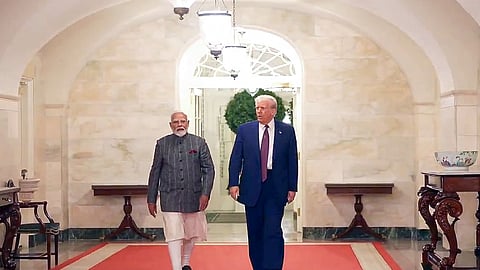

BENGALURU: US Commerce Secretary Howard Lutnick's claim that the US-India trade deal has stalled because Prime Minister Narendra Modi did not call President Trump has added another layer of uncertainty to the much-anticipated agreement. The Ministry of External Affairs hit back, saying the claim was 'not accurate', noting that Modi and Trump had spoken on the phone eight times in 2025.
So far, there have been six rounds of negotiations for a bilateral trade agreement including a framework deal to resolve the 50 percent tariffs on Indian goods entering the US. Lutnick said that conditions have changed now, implying that India is no longer getting the trade deal that was arranged earlier.
In the face of strong geopolitical headwinds, an expert said it was time for a quick reset in India's foreign and domestic policy to deal with the emerging world order, which is far distanced from the rules-based order.
"India has to adjust quickly and thoroughly to survive in this environment of growing imperialism. Imagine being pressured from outside to change our independent foreign policy, which would hurt our global position and stability at home. As old rules fade, survival depends on strong internal balance, not just words," Brigadier Anil Raman (Retd), a research scholar on US domestic politics and foreign policy from the Bengaluru-based Takshashila Institution, told The New Indian Express.
"India needs to fix its weaknesses, reduce social tension, close gaps in governance, and become more unified. Fast administrative reform is essential, since slow progress will not keep up with competition. Military improvements need strong industry and reliable supply chains. India's government must be built to last, focusing on unity and capability. Weakness inside the country invites outside pressure and division," he said.
Raman spoke on the near collapse of rules-based order and rise of personality-based imperialism. The signs of this became clear after the US abducted sitting Venezuelan President Nicolas Maduro and his wife from their heavily-guarded location in Caracas last weekend.
Earlier this week, the White House issued a statement that Trump is discussing options for acquiring Greenland, including potential use of the US military, in a revival of his ambition to control the strategic island despite European objections. In an interview with The New York Times on January 7, Trump said he was governed by his own morality, not international laws or treaties while responding to a question on the limitations of his global authority.
"Right after the Venezuela operation, the Trump administration made its intentions clear. Top officials, including the President, told the press and repeated on Air Force One that the United States would 'run' Venezuela and control its oil resources 'for America.' This is the most direct statement of imperial intent from a US administration since the Cold War ended. This signals a major change in international politics,” said the researcher.
"Instead of just intervening, the US is openly saying it plans to run another country and take its key resources. The Trump Corollary, described in the 2025 National Security Strategy, shows this shift by openly overriding other countries' sovereignty. This move from theory to action highlights changing power shifts. This is imperialism at its most obvious: one country using force or political control over another," said Raman.
He explained that power creates hierarchy, justified by what is useful, not by law or values.
"This reveals the core logic of imperialism: any strategically important place that does not cooperate could face US control. In this way of thinking, powerful countries believe they can dominate others just because it suits their strategy. Geography, alliances, and international law become less important. This approach blurs the borders between adversaries, partners, and dependents. It establishes a situation in which some countries have full sovereignty, while others have it only if they meet certain conditions," he added.
