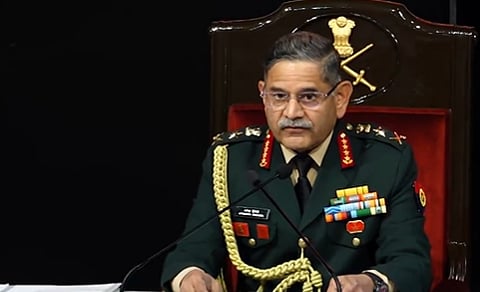

NEW DELHI: Indian Army Chief General Upendra Dwivedi on Tuesday said there was no discussion between Indian and Pakistani military officials on the potential use of nuclear weapons during Operation Sindoor in May last year.
Commenting on the nuclear rhetoric from across the border, he stated, "As far as nuclear rhetoric is concerned, I would like to say that there was no discussion on the issue in the DGMO talks. Whatever nuclear rhetoric was given was by the politicians in Pakistan."
He added that India was "fully prepared to launch ground operations" during Operation Sindoor.
"Based on our information, nearly eight camps are still active. Of these, around two are located opposite the International Border and six across the Line of Control. We believe there is some presence or training activity in these camps, which is why we are keeping a close watch and gathering inputs. If such activity is detected again, we will take whatever action is necessary," the Army Chief said at his annual press conference in the national capital.
He also said the situation along the Line of Actual Control (LAC) with China remains stable but requires constant vigilance.
The top leadership of both countries have met in the last few months, he said, adding that there is a strong sense of urgency within the armed forces to maintain calm along the borders.
"Apex-level interactions, renewed contact, and confidence-building measures are contributing to the gradual normalisation of the situation. This has also enabled grazing, hydrotherapy camps, and other activities along the northern borders," he said.
The Army Chief added, "With our continued strategic orientation on this front, our deployment along the LAC remains balanced and robust. Concurrently, capability development and infrastructure enhancement are progressing through a whole-of-government approach."
He said the LAC needs constant vigil, but both sides are "slowly trying to increase the trust factor".
The Army chief also highlighted the major restructuring being carried out by the force, adding that the Integrated Battle Groups have finally been sanctioned by the government.
He noted that 31 organisational changes have been implemented by the Army including the Integrated Battle Groups.
"We have adopted a spiral development approach centred on organisation rather than equipment alone," Dwivedi said.
The Army Chief said, "We have re-oriented and created several new structures: Rudra Brigades for high-tempo multi-domain ops and Bhairav Battalions for agility and disruptive effect."
He added, "Similarly, Shaktibaan Regiments and Divyastra Batteries of artillery will use UAS/C-UAS (Unmanned Aerial Systems and Counter-UAS) for extended reach and real-time targeting. Ashni Platoons and other organisations on the design board will enhance precision, surveillance and strike options at the tactical level."
As per the plan, the two divisions of the 17 MSC (Mountain Strike Corps), against China, will be converted into four IBGs to be headed by a Major General. These will be offensive strike formations.
The New Indian Express has extensively reported on the formation of IBGs. The concept was finalised in 2018 following which it was reported that the sole Mountain Strike corps at the time would be turned into IBGs, which has now been confirmed by General Dwivedi.
A corps is the largest formation in the Indian Army, capable of waging war independently. The 1.2 million-strong Indian Army is organized into 14 corps, each with troop numbers averaging between 40,000 and 70,000, depending on their role and tasks.
Of the 14 corps, 10 are holding corps, and four are strike corps, tasked with penetrating enemy territory at the outset of war. The four strike corps are the Mathura-based I Corps, the Ambala-based II Corps, the Bhopal-based 21 Corps, and the 17 Corps.
The IBGs are envisioned as agile, brigade-sized combat formations designed to make the Army more lethal and better suited for modern warfare with the support of technology. These formations will be tailor-made based on three factors: threat, terrain and task.
Every IBG will be self-contained, mixing elements of every arm and service according to the terrain and operational requirements. In case of hostilities, the IBGs will be capable of launching swift strikes against the enemy.
The IBGs are expected to be led by a Major-General rank officer. Each IBG will have a troop strength of around 5,000 personnel, larger than a brigade (3,000-3,500 troops) but smaller than a division (10,000-12,000 troops).
These self-sufficient formations will include infantry, artillery, armoured units, engineers, signals, air defence, and other arms and services, enabling them to prepare for combat within 12-48 hours.
