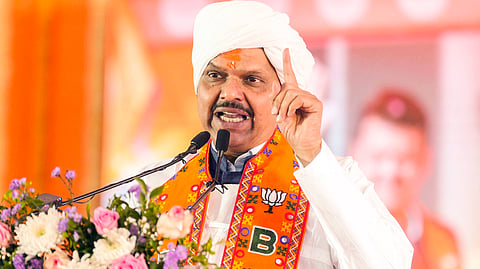

MUMBAI: Devendra Fadnavis’s political journey is one of steady ascent rather than sudden arrival. It began in the narrow lanes of Nagpur’s municipal politics, where he began as a corporator in the Nagpur Municipal Corporation. From there, he rose methodically, emerging as a central force behind the Bharatiya Janata Party’s victories in Maharashtra in the 2014 and 2024 Assembly elections.
That rise culminated in his elevation as chief minister.
His latest achievement has only burnished that reputation. Under his stewardship, the BJP has surged ahead in civic elections across Maharashtra, placing the party firmly on course to capture the Brihanmumbai Municipal Corporation (BMC), Asia’s richest civic body, along with key municipal corporations such as Pune, Navi Mumbai, Nashik, Nagpur, Jalgaon and Kalyan-Dombivli.
The scale of the sweep has reinforced Fadnavis’s image as an election-winning strategist and administrator rolled into one. With the BJP poised to wrest control of Mumbai’s civic crown, Fadnavis’s political standing has entered a new league.
The outcome has strengthened whispers within political circles about his future beyond Maharashtra, placing him among leaders spoken of as potential national faces for the saffron party.
For the BJP, the BMC victory carries deep strategic weight. The undivided Shiv Sena ruled the civic body for nearly 30 years, often with the BJP playing junior partner. That equation cracked in 2017, when the BJP decided to contest the BMC elections independently. It won 82 of the 227 seats, just two short of the Uddhav Thackeray-led Shiv Sena, despite both parties being allies in power at the Centre and in Maharashtra at the time. Though the BJP fell short then, the contest marked a turning point.
Fadnavis used that moment as a foundation rather than a setback. Over the years, he steadily expanded the BJP’s footprint in Mumbai, quietly laying the organisational and political groundwork for the next civic battle.
He combined ideology with delivery, projecting himself not only as a Hindutva standard-bearer but also as a development-oriented leader with a clear infrastructure vision.
During this period, Mumbai saw tangible changes. Metro services were rolled out, easing the city’s chronic commuting stress. The Atal Setu connecting Mumbai and Navi Mumbai was completed, symbolising speed and scale.
Work progressed on the underground coastal road, while the long-delayed redevelopment of the BDD chawls was pushed forward. These projects reshaped Fadnavis’s image from that of a partisan leader to that of an “infra man.”
The message resonated across social and linguistic lines. Aspirational Marathi and non-Marathi voters began to view the BJP as a party capable of reviving a city they believed was stagnating under the Thackerays’ emotive and inward-looking politics.
The promise was clear: growth, jobs and a better quality of life under Fadnavis’s watch. Politically, he worked on multiple fronts. While consolidating the BJP’s traditional vote banks among Gujaratis and North Indians, he also reached out to South Indian voters, particularly in the aftermath of Raj Thackeray’s jibe at Tamil Nadu BJP leader K Annamalai.
Simultaneously, Fadnavis made a direct play for the Marathi vote, long considered the Shiv Sena’s exclusive preserve. Casting himself as a strong Marathi manoos, he foregrounded promises of housing through redevelopment, homes for slum dwellers, employment and security.
The Shiv Sena’s traditional strength lay in its dense network of local shakhas that functioned as neighbourhood power centres.
To challenge this, Devendra Fadnavis, with the BJP’s Mumbai unit, replicated and modernised the model. Party offices spread across the city, and each area was assigned three shakha heads — a man, a woman and a youth — creating a new grassroots leadership pipeline that steadily drew voters towards the BJP.
Simultaneously, the Eknath Shinde-led Shiv Sena weakened Shiv Sena (UBT) by poaching shakha heads, corporators and local leaders, backing them with resources.
Fadnavis reinforced this by directing projects and funds to BJP and Shinde-held areas, giving them visible achievements while the opposition struggled.
Equally significant was Fadnavis’s decision to keep the BMC campaign deliberately restrained. He avoided calling in the BJP’s top national leadership, including Union Home Minister Amit Shah and Prime Minister Narendra Modi, to prevent the contest from slipping into a Marathi-versus-Gujarati narrative.
By doing so, he denied the Thackeray brothers their most familiar political weapon. The battle was framed squarely as one between Fadnavis and the Thackerays, stripping it of emotive distractions.
In another calculated move, Devendra Fadnavis chose not to align with Ajit Pawar’s NCP for the BMC elections, citing Nawab Malik’s alleged links to fugitive don Dawood Ibrahim. Despite sharing power with the NCP at the state and Centre, he consciously distanced the BJP from what he viewed as political baggage.
The decision allowed the party to draw a sharp ideological line and reclaim narrative control. It helped consolidate the BJP’s Hindutva core while reinforcing a long-held message: on issues of national security and ideology, the BJP will not blur lines or make tactical compromises.
