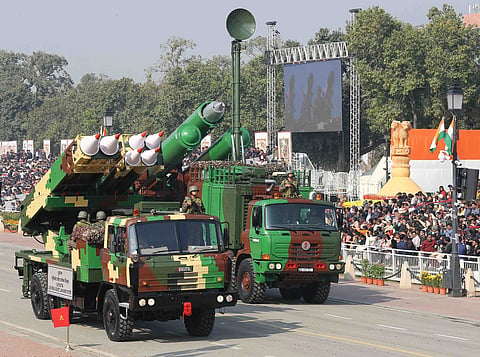

NEW DELHI: The Indian Army, which showcased its newly inducted long-range Indo-Israeli universal rocket launcher system ‘Suryastra’ during this week’s Republic Day parade, has received two launchers. The systems are set for live-fire demonstrations in the coming months, with successful trials expected to lead to follow-on contracts at the regimental level.
According to a statement released by Israeli defence major Elbit Systems on Wednesday, the initial contract, worth Rs. 292 crore, covers two launchers, spare parts, munitions, and a comprehensive support package, structured as a lead programme for potential larger-scale induction. Elbit said live-fire demonstrations in the coming months will determine whether the Indian market expands from this initial batch, combining locally produced platforms with Israeli-developed precision munitions.
“The next phase will focus on scaling up production and deployment if the firing demonstrations meet operational expectations,” the company added.
Sources in the defence and security establishment confirmed that the Army has received two Suryastra launchers along with a replenishment-cum-loader vehicle through the Emergency Procurement (EP) route, which allows acquisitions based on known performance parameters. The requirement for a long-range, deep-strike rocket capability was identified during Operation Sindoor.
As reported by TNIE, the Indian Army had signed the contract earlier this month with private manufacturer NIBE Limited, in collaboration with Israel, for the supply of Suryastra launchers. NIBE will handle domestic production of launchers, while Elbit Systems provides system integration, fire control and advanced munitions.
Under EP rules, the armed forces can acquire systems worth up to Rs. 300 crore urgently, with deliveries scheduled to start within six months and conclude within a year.
Each Suryastra launcher can carry four 306 mm ‘EXTRA’ precision-guided rockets with a range of 150 km and a 120‑kg warhead and two 370 mm ‘Predator Hawk’ tactical missiles with ranges up to 300 km and a 140‑kg warhead. Both munitions have a circular error probable (CEP) of approximately 10 metres, enabling a flexible mix of short- and long-range precision strikes.
“The key advantage is the speed from detecting a target to firing, followed by rapid relocation before the enemy can respond. The PULS-type Suryastra is designed to arrive at a prepared position, receive digital fire orders, launch multiple precision rounds and move quickly to evade counter-battery attacks,” explained a source.
During Operation Sindoor, Pakistan fired a Fatah-II guided rocket, which the Army successfully intercepted over Sirsa. Islamabad claims the rocket can strike targets up to 400 km with high precision. Highlighting that both China and Pakistan maintain dedicated rocket-missile forces, the Army Chief said India is working on raising a rocket-cum-missile force capable of managing conventional ballistic missiles, cruise missiles, and multi-barrel rocket launchers (MBRL).
