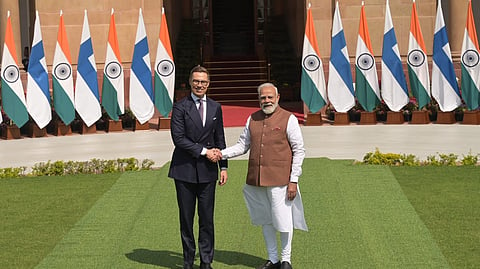

NEW DELHI: Prime Minister Narendra Modi on Thursday said that “no issue can be resolved through military conflict alone” and emphasised that India will continue to support efforts aimed at the swift end of ongoing conflicts, including those in Ukraine and West Asia.
Modi made the remarks after holding bilateral talks with Finland’s President Alexander Stubb in New Delhi, at a time when the global security environment remains volatile amid wars in multiple regions.
“India and Finland both believe in the rule of law, dialogue, and diplomacy. We are in agreement that no issue can be resolved through military conflict alone. Be it Ukraine or West Asia, we will continue to support the swift end of conflicts and every effort towards peace,” he said.
The prime minister’s comments came a day after tensions in the Indian Ocean escalated following the sinking of an Iranian naval vessel by a US submarine, widening instability in West Asia.
Highlighting the broader geopolitical context, Modi said the world was going through a period of uncertainty and conflict.
“Today, the world is passing through a phase of instability and uncertainty. From Ukraine to West Asia, several parts of the world continue to face situations of conflict,” he said.
“In such a global environment, India and Europe, two major diplomatic powers in the world, are entering a golden phase in their relationship. Our growing cooperation is imparting new strength to global stability, development, and shared prosperity,” Modi added.
India and Finland elevated their ties to a Strategic Partnership in Digitalisation and Sustainability, signalling deeper cooperation in emerging technologies, green energy, and economic engagement.
The two sides signed several agreements and outlined an expanded roadmap for collaboration across sectors including trade, sustainability, mobility, and innovation.
Among the key outcomes from Stubb's visit was a Memorandum of Understanding on Migration and Mobility Partnership, aimed at facilitating the movement of skilled professionals.
Finland has increasingly become an important destination for Indian talent, particularly in technology and innovation sectors.
The two countries also renewed an earlier agreement on environmental cooperation signed in 2020. The updated framework expands collaboration in areas such as bioenergy, waste-to-energy technologies, renewable energy systems, green hydrogen, and wind and solar power.
Meanwhile, Modi also stressed the need for global institutional reform and stronger international cooperation.
“We also share the view that reform of global institutions is not only necessary but urgent in order to address the growing global challenges. Furthermore, eliminating terrorism in all its forms remains our shared commitment,” he said.
