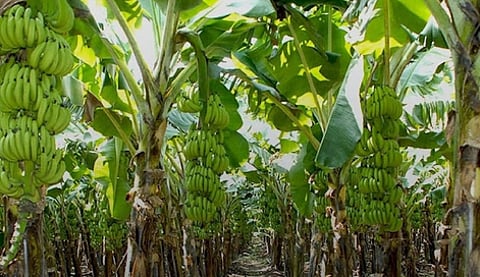

BHOPAL: Thousands of kilometres away from the war zone in West Asia, banana farmers in Madhya Pradesh’s Barwani district are anxiously awaiting an end to the hostilities as the region forms their main export market.
“Agents who buy from us and then export it to the Middle East via bigger fruit merchants say that containers holding as much as 1200 tonnes of bananas are awaiting shipment and transport at ports in Gujarat and Mumbai. If the war doesn’t stop or the sea routes are not opened, the bananas will have to be put on distress sale in the local markets,” Hariom Kumawat, a banana farmer, told TNIE on Friday.
Jagdish Jat, another banana farmer from the same belt which stretches around 2000 hectares in the fertile land on the banks of the Narmada in Barwani district and adjoining Dhar district, said prices had already fallen steeply. “Up to 50% of the banana produce from Barwani district is routed to local, national as well as overseas markets through local agents. The harvest season which started last month will continue till July. When the situation was normal in West Asia, local agents were getting bananas from us at prices ranging between Rs 1900 to Rs 2400 per quintal. But with the ongoing war now halting exports totally, the prices have fallen to Rs 900 to Rs 1200 per quintal,” he said.
Sources engaged in banana farming and trade in Barwani district said that exports peak during the month of Ramadan due to a spurt in demand from West Asian nations including UAE, Iran, Iraq, Qatar, Bahrain and Oman. “This time with the war having started during the same auspicious month, leading to complete halt in exports, we’ve been deprived of our revenue in the best possible period. We pray that the war ends early, failing which we won’t be able to even recover our input costs,” said banana farmer Ajay Kag from Barwani district’s Anjad area.
Though the state’s banana belt is also located in Burhanpur district, which neighbours Maharashtra’s Bhusawal banana belt, it’s bananas from Barwani which are more in demand across the Middle East, particularly during the month of Ramadan.
“The banana plantation, unlike Burhanpur, doesn't rely on tube well water. It’s our state’s lifeline river Narmada, which renders best irrigation to the banana plantations on a unique combination of black and alluvial soil in 2000 hectares, consequently making Barwani’s bananas sweeter than their Burhanpur cousins,” Jagdish Jat said.
Traders who usually handle export consignments say the disruption is unprecedented. Jakku Darbar, a banana trader in the district, says he exports nearly 50 tonnes of bananas to foreign markets during this season, while the district collectively exports more than 200 tonnes. This year, however, the export chain has almost come to a halt due to the war and logistical uncertainties.
Farmers in Burhanpur district – the other major banana belt of MP – sympathised with their counterparts in Barwani.
“The main harvest and export period of quality bananas from Barwani district is between February and July, owing to which their exports have been hit the hardest. Our season spans between June and November. If the war continues like the Russia-Ukraine war, we will lose major business and be forced to go for a distress sale, particularly as 40% of our produce is exported across the Middle East via Dubai,” said Burhanpur-based Rajendra Choukse who grows bananas on a large scale.
