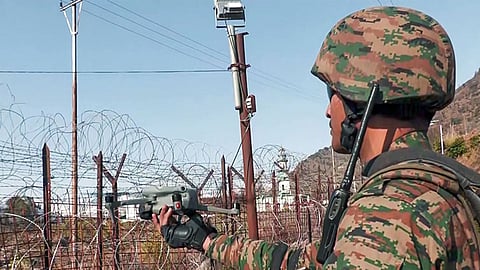

NEW DELHI: Acting on credible intelligence inputs, the Union Ministry of Home Affairs (MHA) has directed security forces to strengthen the security grid along India’s western borders and enhance vigilance in major cities, including Mumbai, Delhi and the Union Territory (UT) of Jammu and Kashmir.
According to officials, intelligence agencies have warned that Pakistan’s military establishment and the Inter-Services Intelligence (ISI) may attempt to push terrorists into the Indian side amid growing internal challenges faced by Pakistan along its western borders and in the southern regions. These developments include tensions with Afghanistan and a worsening insurgency in Balochistan.
The officials said that there has been an assessment within India’s internal security establishment that domestic instability in Pakistan has historically been followed by attempts by state actors there to escalate cross-border terrorism in India. Such moves, they believe, are often aimed at diverting domestic political and security pressures.
A senior official familiar with the assessments said the potential threat to India is closely linked to the deteriorating security situation on Pakistan’s western flank. He noted that Pakistan is currently dealing with what appears to be a near-open military confrontation with Afghanistan, along with intensified insurgent activities in Balochistan.
“These conditions have historically preceded attempts by Pakistan to deflect internal pressure by activating cross-border terror networks against India,” the official said.
Following the intelligence-based assessments, senior leadership within the MHA has asked multiple agencies across the country to step up surveillance, intelligence gathering and counter-terror operations to prevent any escalation.
In Mumbai, the Maharashtra Anti-Terrorism Squad (ATS) has already initiated action. Teams conducted simultaneous raids at three locations in the Kurla and Govandi areas, where searches were carried out at the residences of individuals suspected of being radicalised towards a banned organisation. Authorities said several suspects are currently being questioned as part of the investigation.
Meanwhile, security forces along the Line of Control (LoC) have already thwarted an infiltration attempt. In the early hours of March 4, Army troops foiled a bid at Bhimber Gali, engaging infiltrators and neutralising the attempt without any breach of the border.
Security agencies believe that protests triggered by the killing of Iran’s Supreme Leader Ayatollah Ali Khamenei by US-Israel forces could potentially be used as a pretext to instigate unrest or radical mobilisation.
As part of heightened security measures, multiple review meetings are being held across sensitive regions. Jammu & Kashmir Lieutenant Governor Manoj Sinha chaired a high-level security review meeting in Srinagar with senior police and civil administration officials. During the meeting, he directed officers to remain on high alert and ensure that all necessary measures are taken to maintain public order and peace.
Separately, Northern Command chief Lt Gen Pratik Sharma also convened a meeting in Srinagar with formation commanders and representatives from other security agencies to assess the evolving security environment and coordinate operational preparedness.
Pakistan’s current security challenges stem from what analysts describe as a “two-front situation.” Reports indicate that on February 21, the Pakistan Air Force carried out airstrikes on alleged militant camps in Afghanistan’s Nangarhar, Paktika and Khost provinces, believed to be used by the Tehrik-e-Taliban Pakistan (TTP) and Islamic State Khorasan Province (ISIS-K).
At the same time, Balochistan has witnessed a surge in militant activity. Militants linked to the Baloch Liberation Army (BLA) reportedly carried out coordinated attacks between January 30 and early February across several districts including Quetta, Gwadar, Mastung, Nushki, Pasni and Kharan. The attacks targeted banks, schools, markets, security installations, police stations and a high-security prison, with militants reportedly using firearms, explosives and suicide bombers.
