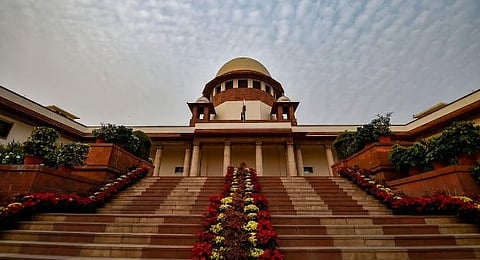

NEW DELHI: The Supreme Court is slated to pronounce its verdict on Wednesday on a plea filed by the father of a 32-year-old man, Harsh Rana, who has been in a comatose condition for more than 12 years, seeking passive euthanasia for his son by withdrawing his artificial life support.
Two medical boards constituted on the orders of the apex court have submitted reports twice, stating that Harsh has no chance of recovery.
Harsh suffered serious head injuries after falling from the fourth floor of a building in 2013. He has been on an artificial life support system for more than 12 years. Following this, his father Ashok Rana moved the apex court seeking directions to grant passive euthanasia for his son by withdrawing the artificial life support.
Before reserving the verdict on January 15, a bench of Justices J B Pardiwala and K V Viswanathan heard submissions from Additional Solicitor General Aishwarya Bhati, appearing for the Union government, and advocate Rashmi Nandakumar, representing the father.
The apex court had also met Ashok Rana during one of the hearings. He has been advocating for passive euthanasia for his son, who has remained in a persistent vegetative state for more than 12 years.
The top court had earlier said it wanted to speak to the parents only in person and not through video conferencing, noting that in such an important matter, online interaction would not be appropriate.
Before deciding to meet the parents, the court carefully went through the report of the All India Institute of Medical Sciences regarding the medical examination of Harsh, who has remained in a vegetative state for the past 12 years after the fall.
After examining the report, the court remarked that it was a "sad report" and said the boy cannot continue to live like this.
The AIIMS, New Delhi, in its secondary report submitted on the directions of the court, examined Harsh’s medical history, neurological condition and other observations. Earlier, the primary report had highlighted that the man’s chances of recovery were negligible.
"The man has been lying on the bed with a tracheostomy tube for respiration and a gastrostomy for feeding. The photographs showed that he has suffered huge bed sores," the primary report said.
As per the guidelines laid down in the 2018 Constitution Bench judgment of the Supreme Court in Common Cause v. Union of India, as modified in a January 2023 order, the court must obtain the opinions of both Primary and Secondary Medical Boards before allowing passive euthanasia.
Passive euthanasia refers to the intentional act of allowing a patient in a long-term vegetative state to die by withholding or withdrawing life support or treatment necessary for maintaining life.