
NEW DELHI: Concerns over a possible shortage of LPG and fuel in India have triggered widespread discussion on social media, with viral posts, videos and local reports highlighting the impact of disruptions linked to the ongoing West Asia conflict.
While headlines have largely focused on India’s oil reserves, the volatility in Middle East energy supply following the US Israel war on Iran has raised concerns about the availability of liquified petroleum gas used widely across households and commercial kitchens. LPG is used by more than 33 crore households and lakhs of eateries across the country.
In several cities, restaurants and small eateries have reportedly begun making temporary adjustments as commercial LPG cylinders become harder to procure.
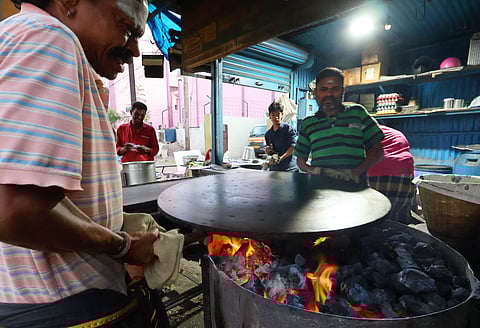
Some establishments in Chennai, Bengaluru and Kolkata have allegedly switched to wood fired stoves using scrap wood to keep kitchens operational, while others have reduced menu items that require longer cooking time.
In Bengaluru, the popular Bangalore Thindies located opposite the ruling Congress state unit office has temporarily restricted its menu to only coffee and tea. Before the disruption, the outlet served around 11 items including dosa, idli, vada and rice dishes.
The cafe owner told that LPG cylinders were available on the black market but allegedly at very high prices.
Hotel owners’ associations in Chennai and Bengaluru have also raised concerns over the supply situation and urged the Centre to restore regular commercial LPG supply, pointing out that the hospitality sector functions as an essential service.
“The industry works on a 24x7 basis in many cases… (we serve) hospitals… besides IT Parks, students, and catering for trains, will be affected without supply of commercial LPG,” said M Ravi, President of a Chennai hotel association, in an appeal addressed to Chief Minister MK Stalin and Prime Minister Narendra Modi.
Similar concerns have been reported in Mumbai and Kolkata. Industry estimates suggest nearly 20 per cent of eateries in Mumbai have temporarily suspended operations due to the shortage.
In Gujarat’s Surat, hotel owners have reportedly been forced to pay as much as Rs 2,200 for a commercial cylinder. Prices were already revised last week, with a 14.2 kg domestic cylinder costing Rs 60 more.
A 19 kg commercial cylinder currently costs around Rs 1,883 in Delhi, Rs 1,835 in Mumbai, Rs 1,990 in Kolkata and Rs 2,043 in Chennai.
Authorities have also increased the waiting period for LPG cylinder bookings from 21 days to 25 days in an effort to prevent hoarding and black marketing. Imported cylinders are reportedly being prioritised for critical facilities such as hospitals.
The supply disruption is linked to tensions in West Asia and the closure of the Strait of Hormuz, a key maritime route through which a significant portion of India’s LPG imports pass.
India imports nearly 62 per cent of its LPG requirements, with around 90 per cent coming from Middle East suppliers such as Qatar, the UAE, Saudi Arabia and Kuwait.
Domestic LPG consumption has also been steadily increasing, rising from 21.61 million tonnes in 2016 17 to 31.32 million tonnes in FY25 before easing slightly to 30.86 million tonnes in FY26.
Amid the situation, Prime Minister Narendra Modi was briefed by Petroleum Minister Hardeep Singh Puri, who earlier said that India remains in a “comfortable position”. He said oil refineries had been directed to increase LPG production for domestic use.
Government sources also said the Union Home Secretary chaired a high level meeting with Chief Secretaries and Director Generals of Police from all states and Union Territories to review the LPG supply situation and ensure smooth distribution.
States were informed that an LPG Control Order issued on March 8, 2026 directs refineries and petrochemical complexes to maximise LPG production and prioritise supply for domestic households.
Meanwhile, several posts circulating on social media have amplified concerns about shortages. Videos showing long queues outside gas agencies and people filling petrol in large containers have been widely shared online, particularly from parts of Tamil Nadu.
In Noida, long queues were reported outside a gas agency in Sector 63 amid concerns over LPG availability linked to the ongoing conflict.
In Chennai, some restaurants have reportedly added a temporary LPG revision fee of Rs 15 to customer bills to offset higher fuel costs.
Amid the concerns, Indian Oil Corporation Ltd also shared an advisory on social media urging consumers to conserve LPG.
The impact has also extended to institutions. Parents of students at The Shri Ram School in Gurugram were recently informed that the school may not be able to serve lunch and snacks from next week if the caterer is unable to procure commercial LPG cylinders.
“Namaste! This is to bring to your urgent attention that our caterer has informed us that he is unable to procure the required quantity of LPG to run the school's lunch and snacks programmes because of the shortage due to ongoing West Asian war,” the email read.
The message added that the caterer currently had only two days of LPG stock left and asked parents to keep alternative meal arrangements ready in case supplies were not restored.
“We request you to keep alternate arrangements ready for your wards for next week unless the situation improves,” the communication said. The email was signed by KA Girija, Head of Administration at the school.
Despite the growing buzz online, some institutions such as government schools in Delhi have not yet faced major disruptions. A school principal said mid day meals were currently being prepared only on a limited scale due to ongoing examinations.
Meanwhile, the Indian Railways has also issued operational guidance to catering operators. According to PTI, IRCTC has asked operators of food plazas, refreshment rooms and Jan Ahaars to switch to alternative cooking arrangements wherever feasible to ensure uninterrupted catering services for passengers.
In Bengaluru, the PG Owners Welfare Association has also advised paying guest accommodation owners to adopt temporary gas conservation measures amid the supply disruption.
The association estimates that the city has between 15,000 and 25,000 PG accommodations that depend heavily on commercial LPG for daily cooking.
As concerns continue to circulate widely online, authorities have urged states to monitor supplies and prevent hoarding, while ensuring essential services receive priority distribution.
