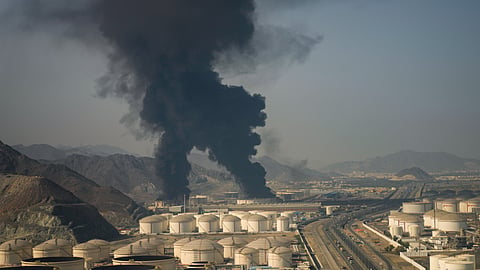

NEW DELHI: As the West Asia conflict escalates, India’s pharmaceutical industry fears a prolonged disruptions to petrochemical supplies critical to drug manufacturing, syringes and packaging could significantly impact the sector.
Such disruption could have a cascading effect: slower production may force patients to pay more for medicines or face shortages of essential drugs such as antibiotics, antidiabetics and cardiovascular treatments relied upon by millions.
Experts note that medicines such as paracetamol, penicillin, antibiotics and sedatives are derived from petrochemical feedstocks such as benzene, toluene and ethylene, which are key building blocks for Active Pharmaceutical Ingredients (APIs).
War's impact on Petrochemicals
In drug manufacturing, petrochemicals are widely used in the synthesis of many small-molecule APIs.
Aromatic compounds such as Benzene derivatives are involved in pathways for the synthesis of analgesics like paracetamol.
It is also used in tablets, injectables and liquid formulations, including polyethylene glycol, polysorbates and parabens.
Beyond medicines, petrochemical-derived plastics and polymers are integral to syringes, IV bags, and diagnostic kits, among others.
Pharmaceutical packaging, too, relies heavily on such materials.
Plastic component in blister packs, ampoules, and high-density polyethene bottles (HDPE) that stores delicate medicines are also derived from petrochemicals
KM Gopakumar, Co-convenor of the Working Group on Access to Medicines and Treatment, said, "This is not just an energy supply problem - it may be a public health problem in the making. India manufactures over 50,000 generic drug formulations, and a substantial share of them depend on petrochemical-derived intermediates, solvents, excipients and packaging materials at some stage of the production chain.”
Industry insiders agree that supply disruptions would have a major impact.
“If the war rages for another month, then even the big pharma companies will also be impacted. Most pharma companies have finished products for at least a few months. The break in the chain will have a ripple effect, which will be felt by the people, who will either buy in bulk to wade through the medicine shortage or will have to pay more.”
While large pharmaceutical firms typically maintain three to six months of inventory, Micro, Small, and Medium Enterprises (MSMEs) often hold only limited stocks. Nearly 200 small manufacturers could halt production within weeks once inventories run out, Gopakumar said.
“The MSME pharmaceutical sector is not just an economic unit - it is the production backbone for affordable generic medicines that supply government health schemes like Pradhan Mantri Jan Aushadhi Kendras, public hospital formularies and rural primary health centres. When the production line is disrupted, the earliest impact is unlikely to be on specialty drugs but on high volume essential drugs such as antibiotics, analgesics, antidiabetics and cardiovascular medicines that hundreds of millions of Indians depend on daily,” he added.
Experts emphasise that petrochemicals underpin not just drug synthesis but also solvents, excipients, packaging, medical devices and diagnostics, making the sector highly sensitive to energy supply disruptions.
Dr Dinesh Dua, former chairman of Pharmexcil, said, “However, the leap from supply-chain stress to an imminent humanitarian crisis is not supported by how these markets historically behave. The more realistic scenario is one of inflationary pressure, selective shortages in low-margin generics, and tighter global trade flows, rather than a systemic breakdown of medicine availability.”
Ravi Udaya Bhaskar of AIDCOC said, “No one is talking about the shortage of medicine. The cost of medicine would increase. However, the National Pharmaceutical Pricing Authority (NPPA) has fixed ceiling prices for essential medicines... What would happen would be that pharma companies may have reduced profits.”
Experts add that the scale of impact will depend on how long the conflict continues.
