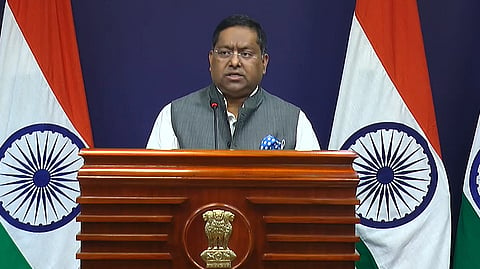

NEW DELHI: The Ministry of External Affairs (MEA) on Thursday termed strikes on Gulf energy facilities as "deeply disturbing", as fresh attacks on gas hubs heightened global concern amid the ongoing West Asia conflict.
MEA spokesperson Randhir Jaiswal called the attacks "unacceptable" and reiterated New Delhi's call to avoid targeting energy infrastructure, warning they risk worsening global energy flows.
"India had previously called for the avoidance of targeting civilian infrastructure, including energy infrastructure, across the region. Recent attacks against energy installations in different locations across this region are therefore deeply disturbing and only serve to further destabilise an already uncertain energy scenario for the whole world," Jaiswal said at his weekly media briefing.
"Such attacks are unacceptable and need to cease," he added.
Jaiswal also confirmed that disruptions in the Strait of Hormuz have begun to impact supplies. "Now with the latest attacks our LNG supply is going to be impacted," he said, adding that India is working with stakeholders to ensure energy security and maintain cargo flows.
"We are in touch with all the stakeholders there to see how best we can secure our energy needs and ensure unimpeded transit for our cargo," the MEA spokesperson added.
Notably, Qatar's main gas facility has suffered extensive damage after several rounds of Iranian strikes, raising fresh energy supply concerns as the Middle East war grinds on.
Iran hit the Ras Laffan refinery, the world's largest liquefied natural gas (LNG) facility, on Wednesday in retaliation for an Israeli attack on its South Pars gas field. The attacks on Ras Laffan and other energy facilities drove Brent crude up more than 10% at one point to over $119 a barrel, before prices pared gains.
The assault on Ras Laffan has also stoked fears of wider disruptions to fuel supplies, including for India, which relies on Qatar for over 40% of its LNG needs — crucial for power generation, industry, fertiliser production and household cooking. Qatar is one of the world's top LNG producers, alongside the United States, Australia and Russia.
With gas shipments already reduced, New Delhi fears a fresh supply crunch, rising costs and deeper economic strain across sectors dependent on steady imports.
Notably, Prime Minister Narendra Modi, in multiple conversations across the region and beyond, has repeatedly stressed diplomacy as the only viable path forward.
“We agreed on the need to prioritise dialogue and diplomacy for de escalation and subsequent restoration of peace and stability,” Modi said after speaking with Sultan of Oman. He also condemned violations of sovereignty and appreciated efforts to facilitate the safe return of stranded nationals.
In his call with French President Emmanuel Macron, Modi highlighted the “urgent need for de escalation. “India and France are working closely together to reduce tensions in the region and to keep diplomacy at the heart of our efforts for peace,” Macron later said.
After speaking to Jordan’s King Abdullah II, Modi said on X, “Attacks on energy infrastructure in West Asia are condemnable and can lead to avoidable escalation. India and Jordan stand in support of unhindered transit of goods and energy.
Energy prices have already surged globally since tanker traffic through the Strait of Hormuz — which normally carries around a fifth of the world's oil and LNG — was brought to a near standstill by the threat of Iranian attacks. As many as 22 Indian ships with over 600 crew are stuck in the Gulf as the key energy corridor remains disrupted.
