
The Congress on Friday welcomed the Supreme Court’s decision to grant anticipatory bail to party leader Pawan Khera in a defamation case, asserting that the rule of law prevails above all. The party also urged Assam Chief Minister Himanta Biswa Sarma to reflect on what it described as his “deeply inappropriate” remarks, which it said had lowered the standards of democratic discourse.
Senior Congress leader and spokesperson Abhishek Singhvi questioned whether it was appropriate for a constitutional functionary to use such language against Khera—remarks that, he noted, were referenced by the apex court in its judgment—and called on Sarma to express regret.
Responding sharply, Sarma said he did not require lessons on democracy, public discourse or decency from anyone, particularly Singhvi, and added that the matter was “just the beginning, not the end”.
The Supreme Court granted pre-arrest bail to Khera in connection with allegations he made about the Assam chief minister’s wife, observing that the dispute appeared to stem from political rivalry. The case had been registered by Assam Police after Khera raised questions about Sarma and his wife’s passport status, triggering a political controversy ahead of the state assembly elections.
Following the remarks, Sarma had made statements about Khera that the Congress termed “inappropriate”.
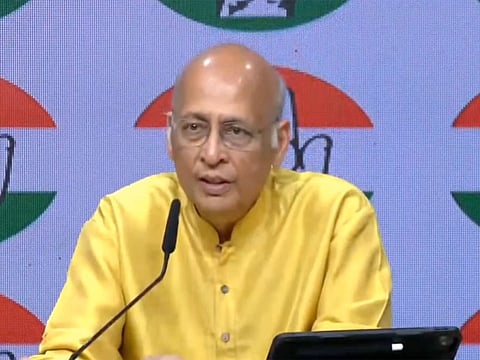
Addressing a press conference, Singhvi said the court’s ruling reaffirmed that when personal liberty is at stake, the judiciary remains a crucial safeguard. “We welcome the Supreme Court’s decision. The Congress party and its leadership commend both the verdict and its promptness,” he said, noting that issues of liberty were central to the case.
Congress general secretary Jairam Ramesh described the ruling as a victory for constitutional values. “Today, the Constitution has emerged victorious. While it faces repeated challenges, this judgment shows that its protections endure,” he said.
Singhvi argued that in cases involving alleged reputational harm, arrest should be a measure of last resort, not the first. He alleged that the intent behind seeking Khera’s arrest was to humiliate and harass him, questioning whether investigation could not proceed without custodial action.
He also pointed out that most of the charges invoked against Khera were bailable, yet there was an apparent push to escalate the matter. “There was an attempt to convert a defamation issue into something more serious, even though nine of the ten provisions invoked were bailable,” he said.
Referring to the judgment, Singhvi said the court had cited several statements made by the Assam chief minister and examined them in detail. He urged Sarma to reconsider his position in light of those observations. “Many of the remarks cited are deeply inappropriate and diminish the standards of our democracy. A person holding a constitutional office must reflect on whether such conduct is befitting,” he said, adding that an expression of regret would enhance the chief minister’s stature.
Sarma, in a post on X, countered the criticism, saying Singhvi was in no position to lecture him on public conduct. He maintained that the issue centred on the alleged defamation of a private individual. “This concerns a woman with no role in politics whose character was targeted on national television using purportedly forged documents,” he said, expressing confidence that the courts would eventually act against those responsible.
“This is just the beginning, not the end. Satyamev Jayate,” Sarma added.
Singhvi, meanwhile, emphasised that democratic systems must preserve space for political dissent. “If political speech made during campaigns is treated as a criminal offence of this nature, it risks undermining the fundamental right to free expression under Article 19(1)(a),” he said.
He concluded that the case underscores a broader principle: however powerful an individual may be, the law remains supreme, and faith in legal institutions ensures that justice ultimately prevails.
(With inputs from PTI)
