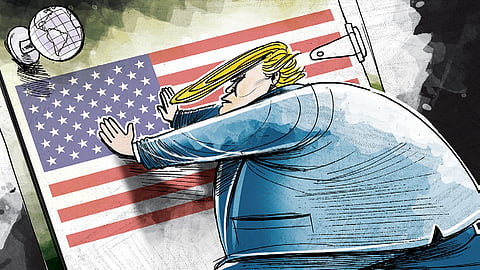

The WhatsApp Universe is caught in a spicy tizzy. Last year, the forwards industry was busy propagating prayers and a havan for Donald Trump’s re-election and a boycott of Chinese goods. This week, as the India-China détente unfolds in Tianjin, touch-screen warriors trashing Trump are in a bind whether Chinese goods are kosher or not.
Beyond the outrage and the compulsions of binary jingoism, the fact is that the answer to the “unfair, unjustified and unreasonable” tariffs imposed by Trump is strengthening the domestic economy. The chasm between reality and potential is littered with systemic burdens imposed on the economy. Making India competitive demands wholesale reforms—of laws, taxation, permissions and compliances.
The tariff threat merits a national response—for a meeting of chief ministers chaired by the Prime Minister to put reforms on the clock. Why the states? As N T Rama Rao said in the 1980s, ‘Every square mile of India is ruled by states.’ The 1991 reforms dismantled licence raj, but left a permission raj intact. The power to liberate factor productivity for boosting growth is vested with the states.
The idea is wrapped in cautionary caveats. It cannot be yet another Vigyan Bhavan photo-op. India must leverage the scale of its economy. What is it that states do to accelerate the virtuous cycle of investment, jobs, income and consumption growth? Typically, the discourse gets wrapped in performative platitudes. The agenda has to be pre-baked and must be about trimming the costs imposed on the economy.
The political class has invested in vote guarantees. Ergo, how about the states presenting their ideas and three changes they guarantee to usher in? For instance Tamil Nadu, along with Karnataka and Gujarat, is able to compete for global investments. Can these states present and share their best practices?
The rigidities in labour laws corrode the promise of enlarging manufacturing’s share in GDP to 25 percent. In 2015, the Centre held consultations with states. By 2020, parliament modified laws on wages, industrial relations, safety and social security. In 2025, the new code is stranded as states are yet to adopt it and frame rules. Will states agree on a deadline to adopt and frame rules?
Enterprises wade through a plethora of registrations to set up business. Will states collaborate and agree on a common interoperable number visible across ministries? Entrepreneurs must get between 30 and 110 clearances to set up a manufacturing unit, a hotel, hospital or a power plant. Once set up, the businesses must survive regulatory cholesterol of thousands of compliances and the swamp of inspector raj. How about doing a flow chart of the permissions for a new national template?
Trump’s tariffs threaten the very viability of exporters and livelihoods of employees producing shrimps, gems and jewellery, garments. Perhaps states such as Andhra Pradesh, Rajasthan, Tamil Nadu, Uttar Pradesh and Rajasthan have ideas and can present a plan to ensure their survival. The vulnerabilities of traditional and hand-crafted exports to loss of business could be severe. Could states spur domestic demand, fund an online platform for the handicrafts of all states?
India is a major exporter of solar equipment to the US and tariffs threaten its viability. The complexities of supply chain and tariffs could render them a casualty. A TeamLease Regtech report reveals renewable energy projects require 799 unique compliances. States can promise to clean up the regulatory mess in the domestic rooftop solar adoption to enable their survival.
There is much hope resting on the promise of ‘next generation’ GST reforms to be defined at the GST Council meeting in September. There are murmurs of loss of revenue—even if GST is often used as an ‘MSP’ for governments to fund populism. Can states agree on minimum definitions—redress the ills of an inverted duty structure where inputs are charged higher than the output? Must GST on yarn be more than fabric and garment, or on soles more than shoes? Can all packaged foods—for instance popcorn—be taxed similarly instead of ingredient based rates?
Sure, programmes require funds. States are vested with surplus lands and can follow asset monetisation plans. There is much debate about central public sector undertakings and little about the state of state PSUs. How about a white paper on which state owns what and how well or poorly they are doing? The Comptroller and Auditor General’s reports reveal the rot and erosion of public wealth. Is this sustainable?
The emerging spectre of disruptions underlines the need for funding skilling and re-skilling. Nobody quite knows the quantum of funds lying in the labour welfare funds managed by states. Can states reveal how these are being used? A recent information request revealed that cess worth ₹70,744.16 crore collected from workers and employers for the welfare of construction workers is lying unused with the states. Worse, these funds are being diverted for other populist purposes.
Social media is replete with counsel on crisis-driven change. Indeed, my 2012 book Accidental India chronicles the phenomenon of India’s crisis-led transformation. There is an entrenched belief that Delhi holds the key for change. The necessary and sufficient conditions for change depend on context. The agenda must focus on equipping India’s economy to sustain in a world where the rule-based order is unravelling into uncertainty.
India’s lament for decades is not about what could not be done, but what could be done and yet was not. The aspiration for a Viksit Bharat rests on what is done now. So that GenNext can croon, like the Huntrix girls in ‘KPop Demon Hunters’, “When darkness meets light, this is what it sounds like.”
Read all columns by Shankkar Aiyar
SHANKKAR AIYAR
Author of The Gated Republic, Aadhaar: A Biometric History of India’s 12 Digit Revolution, and Accidental India
(shankkar.aiyar@gmail.com)
