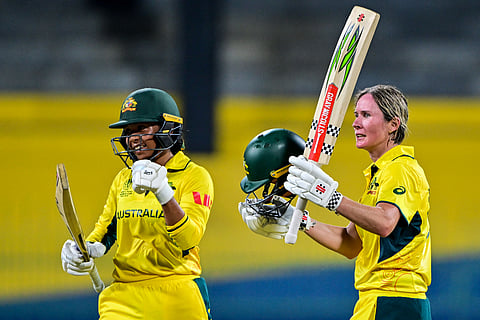

VISAKHAPATNAM: “The wicket's pretty flat. That's probably my key takeaway. I think if the wickets are going to play as flat as they were in that series, then you're going to have to sustain pressure at different points in time and put it back on the opposition when you get the opportunity.” That was Australia captain Alyssa Healy — answering a question about the takeaways from the bilateral series they played against India — during the captains’ media day event in Bengaluru on September 26.
And Healy was not alone in feeling that way. Almost every captain, including India’s Harmanpreet Kaur, echoed the sentiment that the pitches are going to be flat, with batters having a field day. The first two weeks of the World Cup, however, have gone in a different direction.
In the first 11 matches — one game was washed out — only one innings saw a total more than 300; during the Australia versus New Zealand match in Indore. Barring that one match and venue, pitches across the board have on the slower side. It has assisted spinners through the game and under the lights, pacers have been able to move the ball a little bit more.
It meant that the top-order batters have struggled to get going up front, and that reflects in the numbers. Till the New Zealand versus Bangladesh game on Friday, the top three batters cumulatively averaged 24.14 with just one century and five fifties coming in 10 matches. The average is the second lowest among ODI World Cups in this century, only above the 2005 edition in South Africa.
By far, it has been a tournament where the middle and lower middle-order do the heavy lifting. The No 4-6 batters have scored three centuries and five fifties — all these hundreds have come as rescue acts. Beth Mooney against Pakistan, Sophie Devine versus Australia and Ashleigh Gardner in the same game against New Zealand. Similarly, the Nos 7 and 8 have played a crucial role in the fortunes of their respective teams. Three fifties have been scored in those positions — including Amanjot Kaur, Richa Ghosh and Nadine de Klerk — which is the highest for any ODI World Cup and by the looks of it, the number is only going to go up.
It only reemphasises the need for batting depth and why teams are preferring to bat till at least No 8 if not 9. Australia, on a given day could have 11 people who can contribute with the bat. No other team has it, but they have tried their best to match that; sometimes even at the cost of their bowling depth. “I think that's probably what I said earlier about the depth of teams being really important. The pitches have probably done a bit more for the bowlers than we thought. It is a case of you have to pick and choose how you want to play it. You've either got to go out a bit more aggressively and try and knock them off a length and stop it swinging, stop it seaming or try to really grind it out and make it through and get to the spinners and then back your technique against them. It's tough, but I think it's great to see teams having so much depth and ourselves having someone like Charlie Dean at eight playing the way she did the other day. I think it gives a lot of confidence to know that you can go out and play. But if you don't come off, someone else is going to,” England opener Tammy Beaumont said on Friday.

Meanwhile, South Africa all-rounder Nadine de Klerk explained how her role had changed into one of taking the innings deep rather than going hard and playing cameos. “It's not necessarily been 300 plus scores, so I guess it's about just scrapping all the runs you can try and get to a competitive total and then, yeah, obviously back our bowlers to defend that,” she had said. That is exactly what she did during the chase against India on Thursday.
However, there are still three weeks left in the tournament and the top-order batters are bound to find a way to score. Healy said as much on the eve of the India game in Visakhapatnam. "I think the wickets have still been good. Maybe a little bit of pressure has come into play at times, and teams have got themselves into a little bit of a pickle. Having to adapt really quickly is going to be really important,” she said, before adding, “I think it's on our top order to make the bulk of the rounds. I think we can speak on that from both sides.”
The next week or so will give a clearer picture of how the batters adapt and teams operate. For in the end, that is what will determine which team dominates the proceedings when the business ends comes along.