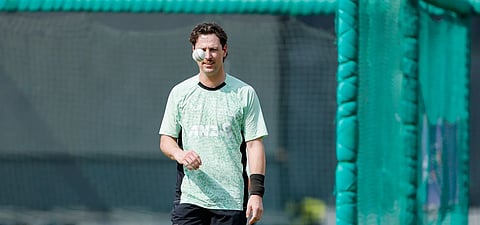

CHENNAI: A little over three weeks ago, Abhishek Sharma was taking guard against Matt Henry in the fourth T20I against New Zealand at the ACA-VDCA Stadium, Visakhapatnam. In the chase of 216, India needed Abhishek to get going as he charged at Henry on the very first ball.
Henry, meanwhile, kept the ball at length on middle stump and angled it away from the left-hander who chased it only to find the fielder specifically positioned in a wide third-man position for that shot. It was not a coincidence where an outside edge found the third man fielder, but a planned set-up to exploit one of the potential weak points of Abhishek.
If there were any doubts, all one has to do is watch Abhishek's dismissal against USA in Mumbai the week after. Cut. Copy. Paste. Teams, bowlers watch what their opponents do, try to bring in new variations and challenge batters, especially when they know the conditions are skewed against them. And it shows in the leading wicket-takers of the T20 World Cup as well. In a list dominated by tweakers, the pacers are the ones with variations and ability to challenge the intangible factors against them.
And New Zealand pacer Henry breaks it down in detail. The first part, planning and preparation that goes in. "I think one of the key elements to bowling here and especially in the power play with two fielders out is the ability to be accurate. Obviously only having two fielders out you can't have them everywhere so you've got to make sure that you're really deliberate on where you guys are so that when you do have an opportunity or a half chance that there's a guy there to take the dismissal. So that's probably where the planning comes in. Like I said it's always nice when it comes off but you've just got to absorb the pressure and do what you can do," Henry explained the Abhishek dismissal to this daily before the T20 WC began.
Second, powerplay wickets become paramount. Henry explains what IPL and the bilaterals have shown how the best way to stop run flow against explosive batters is to get them out. "I think from our point of view as bowlers is how do you stop that and the best way to actually stop it is by getting people out, taking wickets and putting pressure back on the batting team because at the end of the day that's the best way to stop the flow of runs," he said.
However, the difference between bilaterals and the World Cup is that conditions are not the same everywhere. While seamers have enjoyed success under lights and in Sri Lanka, it has not always been the same. New Zealand, for example, have played on some good batting pitches where there is little to no new ball assistance.
This is where the variations, pace off deliveries, short balls, slow bouncers.. etc. come in. Go through the New Zealand bowling column and it shows. Top three wicket-takers are all seamers Jimmy Neesham sharing fourth place alongside Rachin Ravindra. And the top three — Henry, Lockie Ferguson and Jacob Duffy — have all relied on variations to break partnerships. It was something they had prepared for knowing the challenges of bowling under the Sun. "It's probably a positive thing from a bowling point of view where outfield may not be as quick and there might just be a little bit more assistance with your off pace deliveries and be able to create some doubt in the batter's mind with those other options where at the moment the slower balls are sliding on quite nicely and you don't really have too much bounce," he said.
However, it was once again down to accuracy and anticipating where the batter is going to hit. Of the four wickets Henry has to show, one is a cross seam delivery bowled wide and full. The remaining three are either wide and short on pace or slow bouncers, making the batters find fielders in the deep. "I think you've got to probably back yourself with your gut feeling whether they're trying to target you down the ground or trying to hit you square and you're trying to be one step ahead really with your lines and your lengths. So whether you're targeting the stumps and trying to attack that way or whether you're slightly back of a length or full of a length. So all options are probably coming down to your planning. As you know how they're trying to take you down and trying to combo that as best you can using the skill set that you have," explained the 34-year-old.
As New Zealand begin their Super 8 stage against Pakistan on Saturday, they will have a different challenge in front of them. For starters, they will be playing on slower pitches of Sri Lanka. They will also miss Lockie Ferguson, who is going on a paternity leave. At the same time, it will also bring their spinners and the pace variations into picture. And over the next few days, expect the likes of Henry, Duffy, Neesham and Kyle Jamieson to do the same.
