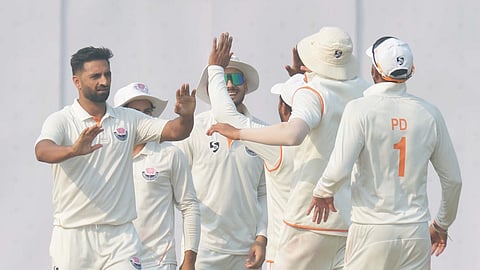

There are victories, and then there are awakenings. For the Jammu & Kashmir cricket team, the six-wicket triumph over two-time champions West Bengal in the 2025–26 Ranji Trophy semi-final in Kalyani was both. It was a moment etched in memory, the long-awaited arrival of something different, something gloriously unexpected. It sealed their maiden entry into a Ranji Trophy final, a red-letter day for the Jammu & Kashmir cricket team, which has lived for decades on the margins of Indian domestic cricket. These men have often been spoken of kindly, but rarely feared.
Like any sporting milestone in a team game, the heroes arrived in waves. Abdul Samad’s fluent 82 in the first innings steadied the pulse, but an unbeaten 30 off just 27 balls in the chase added urgency of imminent suspension of disbelief. Vanshaj Sharma’s calm, unbeaten 43 in the second innings was an essay in composure. But towering above all was Auqib Nabi. With nine wickets in the match and 55 in the season, he bent the game to his rhythm, seam and will. Each spell felt like a declaration.
These men, battle-hardened yet unbowed, tempered by thin air and thicker doubts, were no longer content to merely take the field. They had outgrown the role of gracious participants. They walked out instead as quiet insurgents, ready to outlast, outthink and outplay whatever the game of cricket, in all its fickle cruelty and sudden mercy, chose to hurl at them.
Yet this ascent was forged in heartbreak. Only a season ago, in a cruel quarterfinal against Kerala, J&K lost a semifinal berth by a solitary run on first-innings lead -- 281 to 280 -- after the last pair stitched together an agonising 81. It was their third quarterfinal in 66 years, and it ended in silence. But sport always script comebacks in grit and that silence has now turned into song.
“That pain was gone when we defeated Madhya Pradesh in Indore to make our first semifinal,” Ajay Sharma, the coach, would later say. This season, they did not just heal. They just surged. For a team that began its Ranji journey in 1959-60 and waited 23 years for its first win, the transformation has been profound. Once considered pushovers, J&K signalled intent with a maiden quarterfinal in 2013–14, repeated the feat six years later, and now have rewritten their own ceiling.
Administrative reform played its part. Following court-directed intervention and restructuring, the association saw professional coaching setups, talent hunts, revamped practice facilities and proper red-soil pitches in Jammu. Young pacer Sunil Kumar, a product of these camps, claimed seven wickets in the semifinal. Kookaburra and SG balls replaced worn-out practice gear. Structure bred confidence. And in sports, confidence breeds results.
At the heart of this season’s dominance is Auqib Nabi. Bowling at a brisk 125-133 kph, he has combined seam discipline with relentless accuracy. “Attack the stumps,” is the mantra from bowling coach P Krishnakumar, who believes in simplicity. Against Bengal, after conceding a slender first-innings lead, J&K’s bowlers dismissed them for just 99. Grass on the pitch, disciplined seam positions, and a clear plan exposed technical frailties.
Nabi’s 55 wickets at an average hovering around 12 underline his impact. His performances earned him a lucrative IPL contract with the Delhi Capitals making him one of the most valuable cricketers to emerge from the region. Yet this is not a one-man story. The attack, featuring Sunil Kumar and Yudhvir Singh Charak, has given captain Paras Dogra the rare comfort of believing his team can take 20 wickets on any surface.
Dogra, 41, a veteran of 24 seasons and only the second batter after Wasim Jaffer to cross 10,000 Ranji runs, was entrusted with leadership to build a winning culture. “From the beginning, we talked about winning the Ranji Trophy,” he said. It was belief. There is also a quiet psychological shift. “They don’t see Tendulkar or anyone else” Krishnakumar told the media. “They see a batsman.” The inferiority complex has dissolved. The boys from modest backgrounds, more fluent in cricket than in rhetoric, now focus only on controllables -- length, line, discipline.
Abdul Samad’s all-round spark has added flair to the steel. His counterattacking strokes have often tilted momentum just when games threatened to drift. Now, a final awaits against the formidable Karnataka cricket team at the KSCA Stadium in Hubballi. Back home, anticipation crackles through valleys and towns. For a region that has long yearned for unifying sporting heroes, this team has become more than a sporting side, it is a symbol of emergence. From guest participants to genuine contenders, Jammu & Kashmir’s journey has been patient, painful and purposeful. The underdogs have shed their tag. One match remains between them and history.
