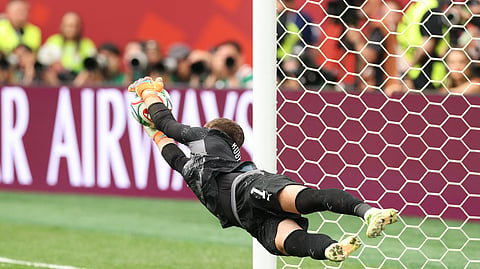

BENGALURU: Lionel Messi is one of the greatest footballers of all time. In one category, though, he's below average. In the art of penalty-taking.
Outside of shootouts, he converts about 77 per cent of all penalties he takes (114 out of 148). Considering the xG of a penalty is 0.79 (the chance of a goal being scored is 79 times out of 100 irrespective of who's taking the penalty), the Argentine is not all that good.
It's an assessment Stefan Szymanski agrees with. One half of one of football's most iconic books — Soccernomics — he's a former Professor of Sports Management at the University of Michigan. Szymanski, whose research has delved deeply into the economics of sport, has taken a deep interest in the psychology of a shootout.
"Both as a keeper or as the one who's standing over the spot-kick," he tells this daily, "you can't always go to your best side."
While there's no right or wrong way to approach a shootout, players are increasingly leaning towards something game theory calls 'mixed strategy'. Assume, for example, the game between France and Spain goes to a shootout. Kylian Mbappe, who is just about average from the spot (81 per cent), may opt for a side that he doesn’t prefer. "That," Szymanski says, "is mixed strategy."
In simple terms, it's Mbappe, deciding in his mind, 'I have gone right, right, left, right, centre, left, left, right, right, centre, right, right in my last 12 attempts... so, do I go left, right or go down the centre?' He will have Unai Simon, the goalkeeper, standing opposite him within earshot, also doing the same calculation. 'I have dived left, left, right, right, left, left, right, right, left, left, right and stood still when I have faced my 12 penalties... so, what do I do now?' People familiar with rock, paper, scissors will have inadvertently used 'mixed strategy' even without thinking about it. Nobody ever uses 'rock' five times at a stretch. Or 'paper' or 'scissors'. It's the same principle.
This whole process, Szymanski says, 'is part science and part art'. "I think what happened originally was when game theory was explained by some of the experts to the teams, it sort of made sense. The part about science is understanding the nature of randomisation and the part about art is getting your body to do the thing you want to do." Chelsea famously hired a professor ahead of the 2008 Champions League final who had approached the problem of the shootout via the prism of game theory. Ignacio Palacios-Huerta compiled a detailed dossier on all Manchester United takers as well as keeper Edwin van der Saar. While Chelsea lost that final in the shootout, Huerta's research proved invaluable; other researchers started looking at shootouts differently.
Almost two decades later, a lot more research and data are available. And goalkeepers, with their cheat sheet stuck onto their water bottles, are more prepared and armed than ever. This sort of arms race between keeper and taker has led to the latter coming up with a tactical innovation -- the stutter-step penalty. "The one kind of change over the years has been the stutter," Szymanski says.
While the stutter has received some bad rep over the last month, a well-taken penalty via this means has the potential to eliminate the keeper. Harry Kane, who has executed stutter-step penalties before, had said he was a fan. Szymanski adds: "I don't think people realised that the goalkeeper had to decide which way to dive before they could know which way the ball was going. You can't anticipate a well-taken penalty. There's a chance to anticipate a badly taken penalty. Part of the stutter-step was the realisation that if you could get the goalkeeper to commit early, then you really had the advantage." Szymanski even goes on to say that the stutter could be the result of people learning about game theory. Research even suggests that a well-executed stutter increases the chances of a goal by as much as 10 per cent over existing trends.
Considering there is data to suggest that most goalkeepers dive left or right rather than standing still, wouldn't a panenka (chipping the ball down the middle like what Mo Salah did against Australia) be a safe option? The former professor says it isn't as simplistic as that. "The left-right dichotomy is a simplification," he says. "There are a host of possibilities that go beyond left and right. And the panenka is the obvious one, but not many players are brave enough to do a panenka because if you screw it up... only the confident, cocky ones can do it." The same thing applies to goalkeepers as well. Given there's data out there that suggests goalkeepers who stand still save a lot of penalties, why do goalkeepers end up diving? "This is where there is the psychological aspect," Szymanski says. "If you stand there and you save it, good for you. You didn't do anything and you saved a penalty. But if you stand there and the ball goes to your left or right, you will look like a real idiot. It will look like you are not even trying. It's much safer for the goalkeeper to make a dramatic dive, even if they don't get the ball the people will say, 'oh well, they tried'.
