
BENGALURU: This has been a great tournament for the stars. The biggest and brightest stars of the game have illuminated grounds in the US, Mexico and Canada over the last month. What has given them competition, though, has been the Video Assistant Referee (VAR).
On the World Cup's penultimate Saturday, VAR was front and centre in both quarter-finals. Here's unpacking the three instances across the two matches...
A Norway goal-kick allegedly hitting the cable over the Stadium, ball falling to the feet of Elliot Anderson and England equalise via Jude Bellingham in first-half injury time
That old FIFA connected ball technology, heartbeat and sensors were all at play. A few replays (admittedly not great angles) suggested a deviation. As soon as Bellingham displayed his dancing feet to evade a few defenders before slotting the ball home, the Norwegian players did appeal to the referee. Even when the game was on, FIFA put out a statement saying they looked at the incident but cleared it because there was no spike when the ball allegedly came into contact with the camera cable up above. Post-match, Norway remained adamant there was a clear change of direction. If there was a deviation, FIFA rules would have disallowed the goal (think about it as the ball hitting spider-cam when in play).
Norway's goal from a corner through Torbjorn Heggem chalked off in the 55th minute because of a Haaland foul on Anderson before the corner is delivered
Keep up here because the irony is delicious. Over the last season, the Premier League saw a lot of grappling from corners with attackers trying to gain an advantage, including 'fouling' defenders. But those actions took place before the corner was hit. In those cases, the play is generally allowed to stand because the attacking phase (at the point of impact of the corner taker delivering the corner) has not yet begun. England even scored a goal in a friendly in March via this route. FIFA cited that game to suggest a tweak of the rules. In the media, it became known as the 'Anti-England' law. The on-field referee didn't spot the infringement, but the Norwegian forward clearly pushes Anderson before the corner is delivered.
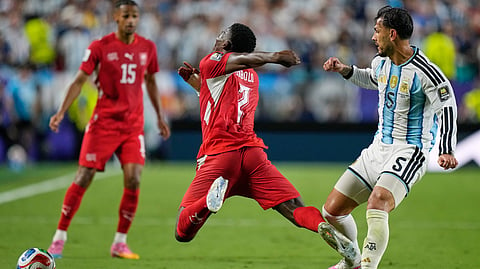
Switzerland's Breel Embolo receiving a second yellow via a 'case of mistaken identity' after Leandro Paredes was initially booked
Embolo, already on a yellow, quite clearly dived after receiving the ball in the second half. Initially, the referee had booked Paredes, thinking the midfielder had fouled the forward. But replays clearly showed that Embolo was the guilty party. So the on-field referee had no choice but to rescind Paredes's yellow and award a second yellow to Embolo to spark scenes of mayhem and confusion. This was exactly how the law was applied in a game between Paraguay and US in the group stage. Curiously, VAR wouldn't have had scope to intervene if the on-field referee hadn't originally given a yellow to Paredes.
