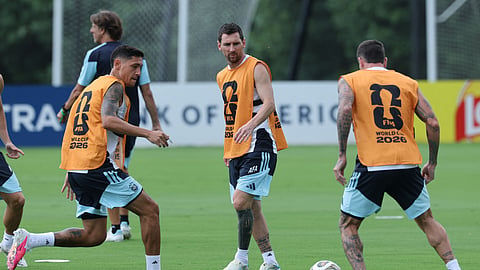

THIS could be the day, then. The World Cup's final Wednesday could also be the final meaningful match of Lionel Messi's international career. Irrespective of whether the 39-year-old, who has eight goals to his name in this tournament, features in the final or in the third-place match a day before, the last dance has gone swimmingly well. He has played some of his greatest hits: the body feints, shake of the hips, drop of the shoulders, that very unique finish with his left foot from just inside the box and even a spell of mayhem as a right winger as he wound back the clock. Just to complete the set, he has even missed a few penalties to stay true to the Messi brand.
A few weeks ago, this newspaper had written how the 39-year-old manages to come alive during critical moments. Unlike other footballers at the elite level, he conserves his energy by walking through large swathes of the games. At this World Cup, he has spent over 60% of the time walking. In fact, data crunchers analysed the group stage numbers and said that out of the 618 players who played at least 90 minutes in the group stage, Messi ranked 618th among all outfielders in terms of distance covered per 90 minutes (8.1 kms).
But his colleagues don't mind this aspect of Messi as this has been a perfectly symbiotic relationship for a very long time. Messi's greatest threat in 2026 is his availability and ability to still engineer moments of magic in and around the D. In the attacking third, he still carries the team. However, in the traditional sense, Argentina have carried him. They have compensated for his lack of off-field movements by running much more than Messi. A few extra yards here. A couple of high-intensity sprints there. One more chase down the right channel at speeds in excess of 20kph.

The data from publicly available FIFA documents make this fairly clear. Among the ever-present Argentina midfielders and forwards in the games Messi has started, the former Barcelona man's press has been fairly non-existent. In the five games he has started, he has run (according to FIFA, anything in Zone 3 or above is a (high-speed run) or a sprint (Zones 4 and 5) 6.21kms. Just to put things in perspective, Harry Kane, who Messi will play against in their semifinal on Wednesday afternoon, has either run or sprinted 6.79kms in the three knockout matches alone.
The defending champions, just like they did in 2022, have subcontracted parts of Messi's expected work-rate to the other players, namely Enzo Fernandez, Rodrigo de Paul, Alexis Mac Allister and, more recently, Julian Alvarez, who was reinstated to the starting XI in the match against Egypt. Messi's 6.21kms compares rather poorly with three of the other ever-present players with Messi in this team. Chelsea's Enzo Fernandez, the skipper's junior by 14 years, has left a bit of himself out on the park in every game.
The midfielder's engine has meant he has run more than double (12.43 kms) than that of Messi in the five games in question (both players didn't start the final league match against Jordan). Before the game against Austria in the group stage, Fernandez had spoken about his admiration for his captain. "Playing alongside him has taught me so many extraordinary things," he said. This is his way of willingly taking on board some of the work Messi would normally have to carry.
Likewise for Rodrigo de Paul, a player frequently referred to as Messi's 'bodyguard'. He has also covered a significant amount of ground in the last three zones. He has run or sprinted 8.8kms in the five games. Alexis Mac Allister, who had a significant drop off with Liverpool last campaign, has been everywhere for the Albiceleste in the US. There hasn't been a blade of grass he hasn't covered, another midfielder who has seemingly run so Messi could walk. He has run or sprinted over 10 kms, including a match high 2.64 against Switzerland in the quarter finals.
Alvarez, who came into the tournament on the back of a niggle, has recovered to start the last two games against Egypt and Switzerland. It has resulted in him running 4.8 kms (Messi at 2.5kms). This arrangement existed in Qatar as well and it looked like an unsustainable arrangement.
Now, three-and-a-half years later, they are 180 minutes (or 210 or 240) away from going back-to-back.