
ON a bus during the 40-hour journey from Tehran to Antalya in March, Iran’s Alireza Beiranvand found it difficult to sit in his seat. His 6’5” frame meant he had to stretch his limbs from time to time.
So, the custodian decided to lie down on the floor while the bus transported members of the Iranian team for one of their training camps after the war broke out in the last week of February.
“They snaked their way from Tehran on a 40-hour bus journey over the Turkish border,” The Athletic had reported before the World Cup. “During that difficult journey, Beiranvand lay in the aisle on the floor to stretch out his long limbs.”
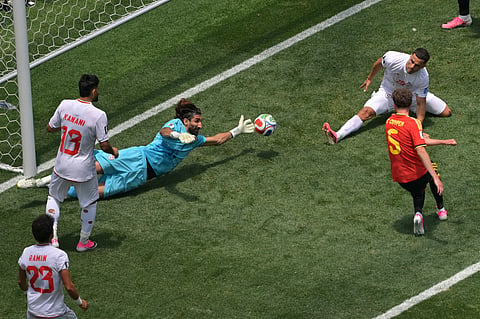
Beiranvand, in his 88th game for the country, was lying on the ground. He had gone down trying to intercept a Kevin de Bruyne cut-back from close range but couldn’t get his hands to it. The goal was gaping and the loose ball was bobbling towards the onrushing Nicolas de Cuyper. A capacity crowd at the SoFi Stadium expected the net to bulge because the goalkeeper was on the floor; face-first and in no position to react. Yet, the 33-year-old reacted just in time as strong his left arm repelled De Cuyper’s goal-bound effort. The save itself had to be seen to be believed.
This has probably been a tournament for the world’s best forwards, but this has also been a tournament for the lesser-known goalkeepers making heroic saves. After Vozinha (Cape Verde) and Eloy Room (Curacao), it’s now Beiranvand.
For a goalkeeper, being spreadeagled on the floor comes with the territory. It’s an occupational hazard. But Beiranvand learned to be prone on the floor long before he had become a storied custodian for Team Melli. Born to a nomadic family in western Iran, he ran away from home because his ambitions in football were being curtailed by his own father.
“My father didn’t like football at all and he asked me to work,” he had once told The Guardian in an interview. “He even tore my clothes and gloves and I played with bare hands several times.” In Tehran, a city where football is very much part of the cultural fabric, he started taking baby steps. Along the way, he had to make do. First, on the streets next to Azadi Tower. Next, by the door of the first club that took him in. At a pizza place he used to work in. Or at the car wash facility. He used to work in all of these places by day. In the afternoon, he would work on his goalkeeping. When it was time to sleep, he used to return to his place of employment.
So, the floor and he had become good friends. "I slept by the club’s door and when I got up in the morning I noticed the coins that people had dropped for me,” he had said in that same Guardian interview. “They had thought I was a beggar. Well, I had a delicious breakfast for the first time in a long while.”
That persistence paid off when Naft Tehran FC turned to him. His imposing frame and shot-stopping abilities attracting the attention of a local goalkeeper without a contract. Five years later, after he had already worn the country's colours for the first time, Persepolis came calling. Persepolis, one of Iran's most well-known sporting clubs, even made him the most expensive Iranian goalkeeper of all time in terms of transfer fees.
At the 2018 World Cup in Saransk, Russia, Beiranvand was again on the floor. He had correctly guessed that Cristiano Ronaldo will strike a penalty to his left-hand side. And the Iranian goalkeeper dived, threw his hand out, stopped the ball before clutching it like it was a family heirloom. It was one of their country's great football moments because they had drawn that game against Ronaldo's Portugal 1-1.
Beiranvand, who now plays for Tractor in the Persian Gulf Pro League, last played a league match on February 26. When he arrived at the World Cup, his competitive match time had been reduced to international friendlies (three) or appearances in the AFC Champions League (one).
It was the same story for the entire Iranian back-line. Ever since the first bombs landed, the league had paused. Some of the players involved in the Persian Gulf Pro League were part of the same 40-hour bus journey that Beiranvand was part of.
Even if Iran had a goal ruled out for a marginal offside, they suffered against Belgium. xG of 0.62 (Belgium had 1.79); 30 per cent possession; seven shots on goal (22) and 15 touches in the opposition box (42).
But what's suffering for 90 minutes for a group of players who were on a bus in a warzone for 40 hours? What's suffering for a group of players who have suffered an awful lot even to get here and then be here?
