
ON August 9, a veneer of silence was shattered; the rules of engagement had subtly changed with respect to how elite athletes publicly viewed Israel's ongoing offensive in Gaza post Hamas's attacks on October 7, 2023. Mo Salah, the Arab and the Muslim world's most influential athlete, changed it with 10 words and three prepositions. "Can you tell us," he asked the UEFA account, "how he died, where, and why?"
It was in response to a tweet from the official UEFA handle about Suleiman al-Obeid's death. Salah did not name Israel, he did not name Palestine, he did not say how Al Obeid was killed but it resonated. It has since generated over 395,000 reposts and over 1.5 million likes.
Referred to as the 'Palestinian Pele', Al-Obeid, 41, was waiting for humanitarian aid with other civilians when he was killed on August 6, according to the Palestine Football Association (an Israel Defence Forces spokesperson has denied the incident). In all, 'the number of footballers killed or who died from starvation has reached 421, including 103 children', as per the PFA in a statement made in the first week of August (Israel has repeatedly challenged the accuracy of the fatality list put out by Gazan officials. They have frequently said it's 'Hamas propaganda').
Mohammad al Sharif wanted to become an Al-Obeid-like figure — a footballer for the Palestine national team. Like many kids, he was a dreamer. He used to keep goal for a local club in Gaza. These days, Al Sharif goes to sleep every night not knowing if he would wake up to see the Sun the following morning (this daily has been in touch with Al Sharif).
According to international media report, since the beginning of the siege, over 650 Palestinian athletes have been killed. Or, to put it another way, an average of one on Monday. One on Tuesday and so on. They have roughly lost one athlete every day for the last 23 months (Israel have repeatedly challenged the death toll).
Everything comes back to October 7, 2023. Hamas killed over 1200 people, injured others and took over 200 hostages. Since that day, Israel has undertaken a massive military operation which has led to the alleged killing of over 64,000 apart from wounding over 165,000, according to reporting by various international agencies (Israel has regularly challenged these numbers). This includes women and children.
A few days ago, the International Association of Genocide Scholars (IAGS) said that Israel's actions constitutes a genocide as laid out by the UN convention on genocide. Israel have always denied accusations of genocide. When IAGS came out with its resolution, they said: "(it was based on) Hamas lies."
What does this have to do with sport? Throughout history, governmental policies — South Africa's apartheid era, Russia's invasion of Ukraine and the US and USSR at the height of the Cold War to name three — have dramatically spilled over to the sporting arenas around the globe.
In the months following Israel's assault on Gaza, sporting institutions maintained the status quo. They didn't want to get involved.
Over the last few months though, this stance is slowly changing. That change will be felt on Tuesday.
On September 8 in Debrecen, Hungary, Italy will line up next to Israel in a FIFA World Cup qualifier. That particular encounter will be played against a backdrop of rising Italian voices who are now batting for Israel's ejection from the qualifiers. In August, the Italian Football Coaches Association (AIAC) urged the football world to 'take action'.

The AIAC Board of Directors, in a letter addressed to the Italian football federation which was to be forwarded to both UEFA and FIFA, wrote: "given the daily massacres, which have also resulted in hundreds of deaths among managers, coaches and athletes... it is legitimate, necessary, indeed a duty, to place at the centre of federation talks the request, to be submitted to UEFA and FIFA, for temporary exclusion of Israel from sporting competitions. Because the pain of the past cannot cloud anyone's conscience and humanity."
Around the time the letter dropped, the Norwegian FA, announced that 'it cannot remain indifferent' to the suffering of innocent civilians in Gaza. "Neither we nor other organisations can remain indifferent to the humanitarian suffering and disproportionate attacks that the civilian population in Gaza has been subjected to for a long time," the body's president, Lise Klaveness, said.
So, they have decided to donate the proceeds of their home qualifier against Israel in October to aid in Gaza. In response, the Israel football federation asked their Norwegian counterpart to condemn the attacks carried out by Hamas.
Why are sporting organisations and world-class athletes beginning to react differently to Israel's sustained offensive in Gaza (Israel has said they have the right of self defence for the continued offensive)?
"In one sense, you could argue that in two years, sport hasn’t moved on in its position on Israel, Palestine and Russia," says Simon Chadwick, a professor on Sport and Geopolitical Economy. "The assertion that what is happening in Palestine is a 'genocide' has led to the softening of attitudes among some, who appear a little more willing to speak out or act. But the reality is that we still don’t have any mass, coordinated or consistent action being undertaken in sport."
Chadwick, a UK academic who has been involved in the sports industry for over 25 years, is more intimate when asked if it's right to view Israel and Gaza through the same prism as Russia and Ukraine (Russian athletes faced immediate isolation after their government invaded Ukraine in 2022). "The reality," says Chadwick, "is that sport is repeatedly being thrust into positions that it didn't anticipate, demanding that people, teams, organisations and sponsors adopt a public position on sometimes highly controversial or sensitive issues. The problem is most athletes, teams and governing bodies still believe that their purpose is to play sport. This means that when difficult situations arise, they are ill equipped to make robust decisions hence they find themselves either compromised and in contradiction or else bland to the point of being mute. Sport needs a strong set of principles to which it adheres so that in situations like Russia and Israel, there is a clear, predictable and consistent response."
Some of the earliest responses following the start of Israel's military operation in Gaza post October 7 was... nothing. Chadwick says it was because 'organisations were unsure about how to respond and what position to take'. "There was even some evidence that sport organisations were using ChatGPT to create their public statements."
That attitude is also changing.
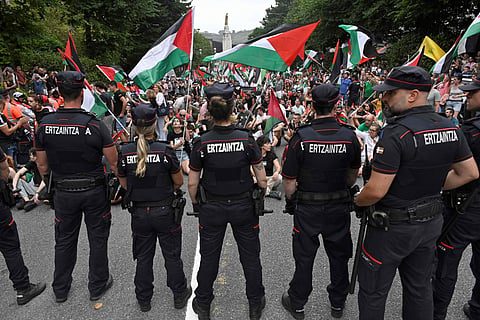
The Vuelta a Espana is one of cycling's most prestigious annual events. It has its own pride of place along with the Giro and le Tour. This past week, the Vuelta witnessed unprecedented scenes as a pro Palestine group targeted the Israel Premier Tech team. After one stage finished with no winners, Spain's foreign minister said he would support the expulsion of the Israel outfit. "We have to send a message to Israel and the Israeli society that Europe and Israel can only have normal relations when human rights are respected," Jose Manuel Albares said.
For the time being at least, the team will continue. On Friday, the Israel Prime Minister Benjamin Netanyahu said he was proud of the team for 'not giving in to hate and intimidation'.
In August, Fortuna Dusseldorf, a football club in Germany's second tier, abandoned the signing of Shon Weissman, an Israel international. Weissman's social media posts expressed support of Israel's activity in Gaza and the fans revolted. Once Dusseldorf pulled out of the deal, the club said: "... statements on social media and subsequent handling of them were not consistent with our values."
Could this be the new normal? A world where foreign ministers embolden sporting organisations to a) allow protests and b) cave in to sustained pressure by fans and stop signings? Right now, there's no concerted effort to isolate Israel on the sporting front by top international sports organisations but does Chadwick see a future where their athletes may see increased sanctions for the acts of their government?
"In essence, markets are driving the moral codes by which decisions in sport are being made," Chadwick says. "This is not just a matter of Israel and Russia, it also involves the likes of athlete transgressions. Organisations are making calculations about what will be most palatable to their fans, consumers, commercial partners and the media that reports about them. In some cases, we are seeing some athletes be very clear about and committed to their personal morals. But for most in sport, to speak or not to speak has become a complex moral, economic, socio-cultural and even religious calculation. Yes, we are living a new normal."
While he says apartheid-era South Africa cannot be compared to Israel -- "the logic of 50 years ago doesn't hold" -- 'the lesson we can nevertheless learn from apartheid-era sport is that mass consensus and collective action does work, though whether this is achievable in 2025 remains to be seen.'
A glimpse of what may be possible could be seen when Israel returns to the football field on Tuesday.