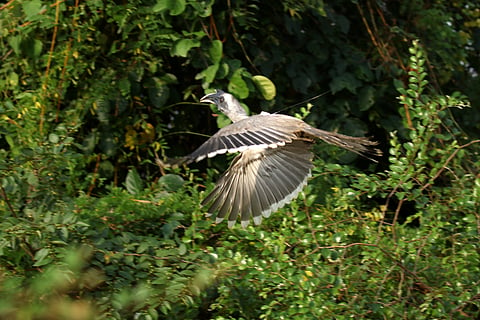

AHMEDABAD: Gujarat has added another landmark achievement to its growing conservation story with the successful return of the Indian Grey Hornbill to the Gir forests after an absence of more than 60 years.
This comes even as the State celebrates the survival of the second Great Indian Bustard chick hatched through the pioneering 'jump-start' conservation technique.
The encouraging findings are from a new scientific study, which reveals that the hornbills reintroduced into Gir have not only survived in the wild but have also bred successfully for four consecutive years, signalling the gradual restoration of a self-sustaining population of a species that vanished from the landscape between the 1950s and 1960s.
The study, titled "Reintroduction of Indian Grey Hornbills in Gir, India: Insights into Ranging, Habitat Use, Nesting and Behavioural Patterns," published in the international peer-reviewed journal Birds, provides the first comprehensive scientific assessment of Gujarat's ambitious species recovery programme led by the Gujarat Forest Department and its conservation partners.
The success reflects India's renewed focus on wildlife restoration through scientific conservation, habitat management, technological monitoring and long-term ecological planning.
Alongside projects for cheetahs, Asiatic lions, tigers, elephants, vultures and the critically endangered Great Indian Bustard, the revival of the Indian Grey Hornbill now stands out as another milestone in the country's expanding conservation efforts.
Speaking on the achievement, Gujarat Forest and Environment Minister Arjun Modhwadia said the State has entered a new era of wildlife recovery, where conservation extends beyond protecting existing species to restoring those that had disappeared from their natural habitats.
"Wildlife conservation in Gujarat has entered a new phase, particularly in species recovery and the protection of rare and endangered wildlife. Grey Hornbills reintroduced into the Gir landscape in 2021 have successfully established territories, adapted to their new habitat and produced offspring, marking a major milestone in restoring a species that disappeared from the region between the 1950s and 1960s. The scientific research conducted after the reintroduction confirms that the project has been a significant conservation success for Gujarat," Modhwadia said.
Minister of State for Forests and Environment Pravin Mali said Gujarat's conservation model has emerged as a benchmark for species recovery programmes.
"The Gujarat model has demonstrated how scientific planning, habitat protection and sustained conservation efforts can successfully restore wildlife. The state takes pride in its achievements in protecting its natural heritage and rebuilding populations of species that were once lost from the landscape," Mali said.
According to Vinod Rao, Principal Secretary, Forests and Environment, the breeding success is perhaps the strongest evidence that the reintroduced birds are naturally establishing themselves in Gir.
"One breeding pair successfully nested during the very first year after release. This was followed by three additional breeding pairs in the second year, clearly indicating that the restored population is beginning to establish itself naturally. The Indian Grey Hornbill is also an ecologically vital species because it disperses seeds over long distances, helping regenerate forests by spreading fruit-bearing tree species across the landscape," Rao said.
The ambitious project involved the phased release of 40 Indian Grey Hornbills into the Gir landscape.
Twenty-eight birds were released during 2021-22, followed by another 12 birds in 2023. To scientifically monitor their survival and adaptation, 11 male hornbills were fitted with satellite transmitters, enabling researchers to continuously track their movements, habitat preferences and breeding behaviour.
Explaining the scientific approach behind the project, Mohan Ram, Conservator of Forests, Junagadh Circle and one of the study's authors, said the birds were carefully translocated from healthy hornbill populations in Gujarat's Aravalli forests only after extensive ecological assessments confirmed that Gir once again possessed suitable habitat for their survival.
"The hornbills were shifted from thriving populations in the Aravalli landscape after detailed habitat evaluations established that Gir had regained the ecological conditions necessary to support the species. Satellite telemetry allowed us to closely monitor how the birds explored, settled and eventually established breeding territories," he said.
The satellite data revealed fascinating behavioural patterns. Newly released hornbills initially explored vast areas while familiarising themselves with their surroundings.
During this exploratory phase, each bird occupied an average home range of nearly 61 square kilometres. However, as they gradually adapted to the Gir ecosystem, their home range shrank dramatically to around 5.7 square kilometres, indicating permanent settlement.
Their movement patterns also reflected successful adaptation. Researchers found that average daily travel reduced from 4.3 kilometres during the initial exploratory period to just 1.4 kilometres after settlement, a behavioural trend commonly observed among successfully reintroduced wildlife establishing stable territories.
The study further found that the hornbills strongly preferred Gir's dry mixed deciduous and teak forests, selecting mature woodland over other habitat types.
Birds dispersing outside the protected area were also observed using orchards, water bodies and landscapes near human settlements, demonstrating remarkable ecological flexibility.
Researchers noted that nesting pairs consistently selected old, large trees with broad trunk girths, particularly Sterculia urens and Terminalia bellirica, underlining the critical importance of preserving mature forests and old-growth trees for the long-term survival of cavity-nesting bird species.
Field observations also documented the birds feeding their chicks primarily with fruits of banyan, peepal, karamda and dhraman, while supplementing their diet with insects and other invertebrates.
As one of nature's most efficient long-distance seed dispersers, the hornbill's return is expected to significantly enhance natural forest regeneration throughout the Gir landscape.
Principal Chief Conservator of Forests (Wildlife) and Chief Wildlife Warden Dr Jaipal Singh said historical evidence suggests that hunting, rather than habitat degradation, was largely responsible for the hornbill's disappearance from Gir several decades ago.
He noted that habitat protection following the declaration of Gir Wildlife Sanctuary in 1965 and Gir National Park in 1975 gradually restored ecological conditions suitable for the species' return.
"The successful breeding, shrinking home ranges and stable habitat use clearly indicate that the reintroduction programme is progressing towards establishing a self-sustaining hornbill population. The Gir project can now serve as a valuable model for future bird reintroduction programmes across India, particularly in landscapes where species have become locally extinct despite suitable habitat remaining available," Dr Singh said.
With four consecutive years of successful breeding, scientific evidence of long-term settlement and healthy ecological adaptation, Gujarat's Indian Grey Hornbill reintroduction programme has now emerged as one of India's most successful bird restoration initiatives, offering fresh hope that species lost from the wild can, with sustained scientific intervention and habitat protection, once again reclaim their place in nature.
