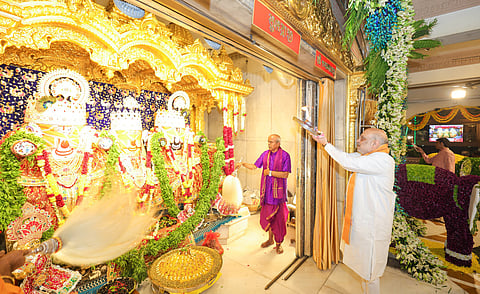

AHMEDABAD: On the auspicious occasion of Lord Jagannath's Rath Yatra, Union Home Minister Amit Shah on Thursday offered prayers at the historic Shri Jagannath Temple in Ahmedabad, reaffirming the BJP's emphasis on blending India's cultural heritage with its development agenda.
After participating in the traditional Mangala Aarti with his family, Shah later held a crucial organisational meeting with senior BJP leaders at the party's Gujarat headquarters, Kamalam, where discussions centred on electoral strategy, voter outreach and strengthening the party machinery.
Extending his greetings to the people of the Gandhinagar Lok Sabha constituency, the entire state of Gujarat and citizens across the country, Shah described the Rath Yatra as a sacred celebration of faith, devotion and India's rich cultural traditions.
He also conveyed New Year greetings to the people of Kutch on the occasion of "Ashadhi Bij", wishing prosperity, happiness and progress for all.
Beginning the day with prayers at the centuries-old Jagannath Temple, Shah joined the Mangala Aarti along with his family and sought the blessings of Lord Jagannath, Lord Balabhadra and Goddess Subhadra.
He prayed for the health, happiness, prosperity and safety of every citizen and sought divine blessings for the country's continued progress and holistic development.
Addressing the gathering after the prayers, Shah said the Rath Yatra was far more than a religious ritual, calling it a living embodiment of India's civilisational values.
"Lord Jagannath's Rath Yatra is not merely a religious tradition. It is a living symbol of India's culture, social harmony, service, unity and public welfare. As the nation progresses on the path of development, our resolve to preserve and pass on India's ancient cultural heritage to future generations is moving forward with equal commitment," Shah said.

Linking cultural preservation with governance, the Union Home Minister asserted that the Narendra Modi-led government has consistently worked to safeguard the country's spiritual and historical legacy while accelerating economic and infrastructure development.
"Guided by Prime Minister Narendra Modi's vision of 'Vikas Bhi, Virasat Bhi', the BJP government is committed to preserving, promoting and developing India's cultural heritage, historical monuments, spiritual centres and civilisational legacy alongside modern development," he said.
Recalling his annual participation in the Mangala Aarti during the Rath Yatra, Shah said the occasion provided him with spiritual strength and renewed inspiration for public service.
"Every year, participating in the Mangala Aarti at Shri Jagannath Temple during Rath Yatra fills me with spiritual peace, renewed energy and inspiration for national service. I pray that with Lord Jagannath's blessings, India continues its journey of progress, every citizen lives a life of happiness and prosperity, and the nation earns even greater respect across the world," he said.
Soon after the religious programme, Shah shifted focus to organisational affairs by chairing a high-level meeting at the BJP's state headquarters, Kamalam, in Gandhinagar.
Senior office-bearers of the state unit and key organisational leaders attended the closed-door meeting, signalling the party's preparations for upcoming political challenges.
According to party sources, the meeting focused extensively on organisational strengthening and electoral planning following the publication of the revised voter list.
The leadership reviewed strategies to expand voter outreach, enhance grassroots engagement and ensure that the party's organisational network remains active across every constituency.
Sources said special emphasis was laid on energising page presidents and booth-level workers, who form the backbone of the BJP's election machinery.
The leadership is understood to have reviewed their functioning and discussed measures to improve coordination, communication and voter mobilisation at the grassroots level.
The meeting also reportedly analysed the BJP's performance in the recent local body elections.
Areas where the party failed to achieve expected results came under review, with discussions focusing on identifying organisational shortcomings and improving electoral performance before future contests.
Party insiders indicated that organisational discipline also figured prominently during the deliberations.
The leadership is learnt to have discussed issues related to factionalism, accountability and performance within the organisation, with responsibility likely to be fixed wherever weaknesses were identified.
Sources further said the leadership is expected to adopt a firm approach against indiscipline within the party organisation.
Necessary instructions may be issued to strengthen internal discipline, improve coordination among office-bearers and ensure that organisational objectives are implemented effectively across Gujarat.