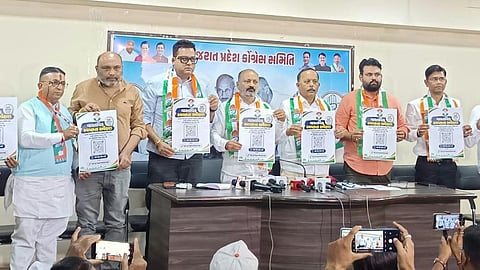

AHMEDABAD: The Gujarat Congress has questioned the Swachh Survekshan 2025-26 rankings, alleging that the cleanliness awards won by Ahmedabad, Surat and Vadodara do not reflect conditions on the ground. The opposition has demanded transparency in the survey methodology, citizen feedback and municipal expenditure, claiming that residents continue to face garbage accumulation, foul odours, pollution and poorly maintained public toilets.
Addressing a joint press conference at Rajiv Gandhi Bhavan, the Gujarat Pradesh Congress Committee's Media Department accused the BJP government of projecting the rankings as administrative achievements while ignoring everyday civic problems.
It questioned whether citizens were actually benefiting from cleaner streets, better air quality, scientific waste disposal and hygienic public facilities, or whether cleanliness had become a "numbers game" on paper.
The Congress clarified that its criticism was not directed at sanitation workers, whose contributions deserved recognition. Instead, it questioned whether their hard work was being used to shield administrative failures, political publicity and contractors' interests. The party also demanded accountability for workers' safety, working conditions and the equipment provided to them.
Pirana dumping site and pollution under scanner
Questioning Ahmedabad's cleanliness claims, the Congress highlighted complaints from areas surrounding the Pirana dumping site and neighbourhoods such as Prahladnagar, Vejalpur, Jivraj Park, Satellite, Danilimda and Narol.
According to the party, residents in several localities continue to complain about garbage accumulation, foul smells and pollution. It claimed that the stench in some residential areas is so severe that residents face difficulties operating air conditioners, as the odour affects filters and machinery.
"If Ahmedabad and Surat are being projected as among the country's cleanest cities, why is this cleanliness not visible in every ward, residential society and slum settlement?" Congress leaders asked.
They argued that cleanliness cannot be judged merely by the appearance of prominent roads such as Sindhu Bhavan Road and SG Highway or areas frequented by VIPs.
The opposition said air quality, sewage disposal, wastewater management, public health and scientific waste processing must receive as much attention as garbage clearance. It demanded an explanation for the contrast between the cities' award-winning images and the conditions reported by residents.
Congress questions survey methodology and citizen feedback
The party also questioned the credibility of the survey's citizen feedback mechanism and sought city-wise details of participation from Ahmedabad, Surat and Vadodara.
Citing government figures, the Congress said the 2025-26 survey covered 4,751 cities, received approximately 2.7 crore citizen responses and evaluated urban centres against 43 criteria across 10 domains. More than 3,000 trained assessors were reportedly deployed for field verification.
However, it argued that these national figures did not reveal the extent of participation by Gujarat's urban residents.
The Congress demanded disclosure of the number of citizens who provided feedback in each city, the proportion of responses relative to the population, and the share received through online platforms, QR codes, the Swachhata app and other channels.
It also sought clarification on how duplicate responses were prevented, how respondents' identities and city residency were verified, and what safeguards were in place for submissions through mobile numbers and OTPs.
Questioning reports that sanitation workers and municipal officials distributed QR codes to citizens, Congress leaders asked whether the feedback was genuinely voluntary or collected under the influence of local authorities. They said collecting public responses and ensuring their independence were two different matters.
The party further demanded ward-wise inspection details, GPS-based verification records and information about the locations visited by assessors. It argued that inspections of a few prominent roads could not represent the cleanliness of an entire city.
Congress objects to BJP's interpretation of rankings
The opposition accused the BJP of exaggerating the results by presenting category-specific achievements as overall national rankings.
Under this year's results, Ahmedabad and Sanand were recognised in the 'Clean City Pair' category, Surat figured among the top three in the 'Super Swachh League', while Vadodara secured recognition in the state's top clean city category.
The Congress said these distinctions must be presented in their proper context. Ahmedabad's recognition was jointly awarded with Sanand and could not be portrayed as the city independently securing the country's top position. Similarly, Surat's Super Swachh League ranking and Vadodara's state-level recognition should not be projected as equivalent national rankings.
The party also insisted that comparisons with cities such as Bengaluru and Hyderabad must follow uniform criteria rather than political convenience.
Waste segregation and public toilets raise concerns
The Congress questioned claims that wet and dry waste were being collected separately from every household. It alleged that residents in several areas had complained of municipal collection vehicles mixing the two categories during transportation, defeating the purpose of segregation at source.
The party demanded city-wise data on daily waste generation, quantities of wet and dry waste, scientific processing, recycling and the amount ultimately transported to dumping sites.
Public toilets also came under scrutiny, with the Congress citing facilities near Paldi crossroads and Jivraj Park in Ahmedabad as examples where citizens reportedly face problems relating to hygiene, water availability, foul smells and maintenance.
Congress leaders challenged BJP office-bearers to accompany them on visits to public toilets in Ahmedabad, Surat and Vadodara to assess the conditions themselves.
The party demanded a location-wise list of public toilets, cleaning schedules, details of maintenance contractors and records of complaints and their resolution. It particularly highlighted the need for safe and hygienic facilities for women.
Congress questions reel competition and toilet expenditure
The Congress also criticised the government's publicity campaign inviting reels and jingles across eight cleanliness-related categories. It claimed that although 48 prizes were announced, only 33 participants entered the competition, forcing its cancellation. The party described this as evidence of a disconnect between the government's publicity-driven approach and public participation.
It also raised questions over the estimated expenditure on preliminary planning and design work for a single public toilet.
According to a proposal cited by the opposition, the projected costs included Rs 15,000 for site surveys and feasibility reports, Rs 15,500 for conceptual designs, Rs 40,000 for a miniature model and Rs 1.65 lakh for electrical and plumbing drawings.
The Congress demanded details of the tendering process, agencies involved, number of bidders, approval of estimates and quality checks. It questioned why such substantial amounts were being earmarked for preliminary design work and whether public money was being spent efficiently.
"If these estimates are correct, who approved them, who received the contracts and who verified the actual utility of the work?" the party asked, demanding an impartial probe if any irregularities were found.
The Congress maintained that cleanliness awards should translate into healthier neighbourhoods and better civic facilities rather than government publicity campaigns. It said the BJP must answer questions over pollution, waste management, public toilets and municipal spending instead of relying on rankings to claim administrative success.
