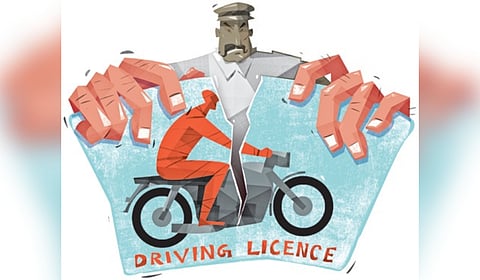

BENGALURU: Despite structured initiatives such as National Road Safety Month campaigns, targeted interventions for vulnerable road users, and the introduction of scientific driving tests, road accidents involving minors and young riders persist.
The trend has raised serious concern, highlighting gaps in training, weak hazard perception, underage driving, and unsafe riding practices that undermine enforcement and awareness efforts. While enforcement is questioned, authorities maintain that prevention begins much earlier — at the licensing stage and through sustained behavioural change.
Scientific licensing: The first line of defence
The issuance of driving licences is governed by the Motor Vehicles Act, 1988, and Central Motor Vehicles Rules (CMVR), 1989. These laws incorporate strict procedural safeguards to ensure only competent drivers are permitted on the roads.
Scientific driving tests mandated under Rule 15 of the CMVR include computerised test tracks, automated evaluation of manoeuvres, and elimination of human discretion. Before obtaining a permanent licence, applicants must pass a mandatory learner’s test under Rule 11, covering traffic signs, road rules and defensive driving principles.
Minimum age, medical fitness, and vision standards directly address common factors in youth-related accidents and prevent underage drivers from legally driving in traffic. Licensing is vehicle-class specific, ensuring drivers operate only the vehicles they are trained for.
Karnataka’s shift to Automated Driving Test Tracks (ADTTs) has strengthened skill-based licensing and reduced unsafe practices such as wrong-lane driving and poor braking control.
Beyond revenue: A coordinated safety framework
Beyond licensing, the role of the Karnataka Transport Department and Karnataka State Road Safety Authority (KSRSA) extends far beyond enforcement. Under the Karnataka State Road Safety Authority Act and Rules, KSRSA serves as the nodal body for road safety.
Its mandate includes policy formulation, inter-departmental coordination, data-driven planning, engineering improvements and public awareness — ensuring that accident prevention is treated as a governance and public health priority.
The transport department enforces licensing standards, vehicle fitness and permit conditions, while supporting technology-based enforcement. Penalties and fees are regulatory tools to deter unsafe behaviour; revenue generation is incidental, not the objective.
The department has multiple awareness programmes chalked out, with focus areas that include helmet and seatbelt compliance, preventing drunk and distracted driving and behavioural change.
For young and first-time drivers, awareness plays a critical role. KSRSA conducts statewide campaigns during National Road Safety Month each January-February, organising programmes in schools, colleges, transport hubs and industrial areas. Focus areas include helmet and seatbelt compliance, speed management, and prevention of drunk and distracted driving.
Special drives target vulnerable road users such as two-wheeler riders, pedestrians, school children and commercial drivers. Campaigns leverage social media, newspapers, television, cinema theatres, billboards and LED screens to highlight pressing road safety concerns. Particular emphasis is placed on pillion helmet usage, night-time visibility and defensive riding — areas often linked to youth accidents.
KSRSA notes improved helmet compliance and positive behavioural shifts following sustained campaigns. Authorities say that while awareness alone cannot eliminate accidents, it is only when combined with engineering, enforcement and education, that it forms a critical pillar of Karnataka’s road safety strategy.
