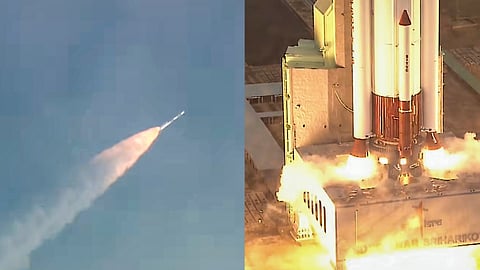

BENGALURU: The failure of the Polar Satellite Launch Vehicle (PSLV)-C62-EOS-N1 mission has shaken the confidence of space startups and raised concerns, particularly over insurance.
None of the satellites from Indian private space companies that were on the launch vehicle were insured. This is because Indian private insurance agencies do not offer any budget-friendly insurance schemes for the growing space sector.
A senior Indian Space Research Organisation (ISRO) official, not wanting to be named, said that earlier, satellites were launched by only government agencies for the government and the insurance was not necessary.
But now, with the space sector opening up for the private sector, the same trust factor has continued without safety nets, like insurance. Also, this was the first time that a PSLV carrying commercial satellites failed.
NSIL: Not responsible for insuring satellites
Interestingly, ISRO insures its satellites when they are launched from foreign soil, but takes no such precautions when doing so from within the country. Officials at New Space India Ltd (NSIL), the commercial arm of ISRO, said they do not take the responsibility of insuring satellites. “Any satellite company coming for partnership and launch should get their own insurance. Foreign agencies partnering with us do it. We do not get involved in insurance. NSIL provides only the platform for MoUs, but it is for the firms to protect their assets,” a senior NSIL official said.
Though this topic was always discussed, it has gained momentum with the draft of new space policy being finalised. An official at the Ministry of Space said, “The entire concept is new. The space policy is being finalised and a lot of discussion is happening on insurance. There is a need to make it mandatory for the sector to grow safely.”
Private space agencies working closely with ISRO termed it a chicken-and-egg conundrum. They wondered that if the policy makes insurance mandatory, who will insure the satellites and at what cost.
An Indian space agency that was to launch its satellite said, “We did not insure the satellite because it is a costly affair and we trusted ISRO. But now we are worried. While globally, companies and their products are insured, it is not so in India.”

Another private space agency representative, working closely with ISRO, said, “Only large companies opt for insurance. This is because the insurance is around 50% of the entire product cost which smaller or funded agencies cannot afford. The failure of PSLV-C62/EOS-N1 has shaken people’s confidence in the sector.”
Insurance agencies, however, said this concept needs a thorough look. Chirag Davda, an insurance agent with LIC, said machinery, road, marine vehicles and tools are insured, but not satellites. This is because these are experiments and involve high risk, he added.
Kalyan Devikumar, an insurance expert with Oriental Insurance, said that at present, government-run insurance companies provide insurance to aerospace sector firms. But only instruments and components of satellites and rockets are insured for a short time.
One payload survives ISRO’s PSLV failure
Bengaluru: Spanish startup Orbital Paradigm on Tuesday said that their experimental re-entry capsule survived the launch anomaly and was able to transmit the data back to Earth. The ‘Kestrel Initial Demonstrator’, or KID, capsule, a 25-kg football-sized prototype not only managed to separate from the spacecraft but also transmitted data.
“Our KID capsule, against all odds, separated from PSLV C62, switched on, and transmitted data. We’re reconstructing trajectory. Full report will come soon,” Orbital Paradigm’s handle posted on X. The KID served as a tech demonstrator and prototype for the company’s proposed vehicle, Kernel, which is designed to return up to 120 kg of payload from orbit to Earth. However, questions remained over how the satellite separated from the PSLV 4th stage capsule and managed to send data.