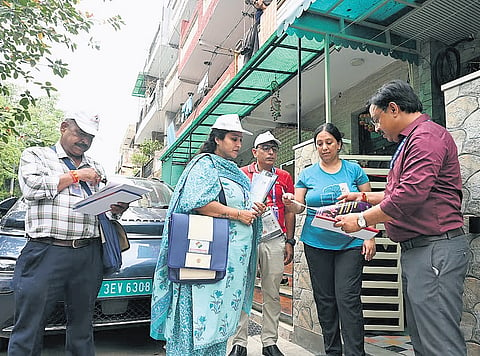

A clean, legitimate list of voters is the essential scaffolding for democracy. The Election Commission of India has rolled out the Special Intensive Revision of voters’ list across Karnataka with booth-level officers as its messengers as well as executives. TNIE reporters fanned out across the state to understand how BLOs, the pawns on the electoral chessboard, move to prepare the ground for the dance of democracy
Bengaluru
Every day is a new lesson
Syeda Saleha Farheen, a teacher who has been assigned as Booth Level Officer (BLO) at Shivajinagar in Bengaluru, makes it a point to answer the queries of her students, despite her Special Intensive Revision (SIR) trudge. She leaves home at 8am every day and once home, she prepares notes for the students.
“I have been allotted 1,021 voters. The distribution of around 800 forms has been completed. In some cases, I am unable to find people or some are dead. I am taking the help of Booth Level Agents (BLAs) and neighbours to ascertain the details of voters. The task in hand is challenging, but not difficult. Earlier citizens were reluctant, but in the past 10 days, they have been cooperating,” she said.
But basic concerns such as food and hygiene persist.
“In some areas there is no access to washrooms or food is not available. Many of the BLOs are women. While some citizens welcome us into their homes, many say leave the forms near the gate or at the window. We leave them, but the worry is how will they return the forms. Establishing basic communication with some citizens is still a challenge,” said another BLO, not wanting to be named.
The case of Girijamma (50), a BLO in Dasarahalli, is different. She said, “We cannot refuse people offering us anything. They feel hurt. I am allotted 1,475 voters and I have been able to distribute only 500 forms so far. Searching for details of people, finding them at their timings and helping them filing the forms are a cumbersome task. But those need to be completed. A daily target of 100-150 was set, but many of us are unable to meet it. I am taking the help of political parties to reach out to people,” she said.
– Bosky Khanna
Vijayapura
Finding the voter is the key challenge
Visiting individual houses to hand over enumeration forms has left BLOs exhausted. “I am tasked with 1,350 enumeration forms. Locating the houses is very time-consuming,” said one of the BLOs.
Then there are phone calls from voters who seek clarifications. “Our day starts at 9:30am and continues till 6:30pm. We get a mini break for lunch,” he said.
Another BLO admitted that the job is stressful but said the work does not take a toll on their physical and mental health if they can manage it properly. “Different people have different stress managing levels. Those who take calls and jobs extremely personally will surely suffer. But those who take it as a job can easily manage their stress and do the job productively,” he said.
The BLOs said their superiors have advised them to work without getting stressed. Many officials who are facing medical issues have been exempted from SIR duty.
Despite training, some BLOs admit they are facing complaints. “People ask what they should do if their names and those of their parents are not on the 2002 electoral rolls. In such cases, we call up our trainers for clarity,” a BLO said.
Some of them are hoping the Election Commission will extend the SIR deadline if the task is incomplete by the end of the month.
– Firoz Rozindar
Belagavi
Language barrier keeps them on their toes
The long-standing border dispute between Karnataka and Maharashtra, and the resulting Kannada-Marathi language divide has added to the workload of BLOs in Belagavi. A large number of government schoolteachers has been assigned as BLOs and BLO supervisors for the SIR.
A BLO said the language barrier has made the SIR difficult in Belagavi. Many residents are Marathi-speaking, while official documents and forms are primarily in Kannada. As a result, BLOs often spend considerable time explaining the forms and assisting families in completing documentation.
“Door-to-door verification itself is time-consuming, but communication becomes even more challenging when residents are unable to understand Kannada. In several cases, completing verification for a single household takes up to two hours,” the BLO said. The official said balancing school responsibilities with election-related duties is tough. Teachers frequently continue SIR work well into the evening after school hours, leaving little time for lesson preparation and academic activities.
According to the BLO, the deployment of trained teachers for election work has affected classroom teaching. While some schools have assigned classes to other teachers, substitute arrangements often place additional burden on the remaining staff.
– Tushar Majukar
Madikeri
SIR rolls on amid rain and wildlife threat
As per official data, 82.23 per cent of enumeration forms has been distributed in Kodagu. But BLOs are up against nature, wildlife, unrealistic expectations, power failures and absence of network connectivity. Accessibility challenges are slowing down the process in interior tribal settlements and forest-fringe areas.
A teacher, doubling as BLO in a remote tribal settlement, said she has to first educate voters due to lack of awareness among tribal communities. Working in a region accessible only by a boat across the Cauvery, she balances her primary duties as the only teacher in a government school, alongside the SIR process. “Because residents leave for daily wage labour early in the morning, visits are limited to evenings. However, if I delay, I might miss the boat back to shore,” she said.
Several BLOs say they are working under the constant shadow of wildlife attacks. “The authorities order us to distribute 200 forms per day, which is highly impossible. We get drenched in heavy rain, get bitten by leeches, and risk our lives in forests. If we die on duty, it’s only our families who will care,” a BLO said.
The challenge is also because of the timing of the initiative. “During monsoon, roads become treacherous slush, and paths through dense forest present real, life-threatening dangers,” another BLO posted in an interior village said.
– Prajna GR
Ballari
Strain on health and family life
BLOs in Ballari district say the SIR workload has taken a toll on their health, family life and routine government duties.
Most BLOs, who are school teachers and government employees, begin door-to-door visits early in the morning before attending to their regular assignments, and continue verification work until late evening. Besides distributing enumeration forms, they are required to explain the revised procedure, verify documents, assist elderly and illiterate voters in filling forms, and collect the completed applications.
“We are covering nearly 150-200 households every day. Many residents are unavailable during the day, forcing us to revisit houses in the evening. The work is physically exhausting,” said a BLO from Ballari city.
A BLO from Siruguppa taluk said a day-long orientation programme was held on the SIR process and digital reporting, but field-level challenges are far greater than classroom training. “People have several doubts about the documents required. Many elderly voters are anxious about whether their names will remain on the electoral roll, and we spend considerable time clarifying their concerns,” the officer said.
Officials say the district has recorded steady progress in distributing and collecting enumeration forms, but BLOs admit balancing official responsibilities with SIR work has become increasingly difficult.
– Kiran Balannanavar
Shivamogga
Addressing voter anxiety a key challenge
In Shivamogga district, 1,793 BLOs are reaching out to an electorate of 12,44,670 voters. Each BLO has to handle 600 to 900 enumeration forms. The primary challenge is not the distribution of forms, but acting as a frontline grievance handler for anxious voters as they feel their SIR procedure might fail and they will be eliminated from the voters’ list.
“The training made it look like a straightforward drop-and-collect task,” said Suresh S (name changed), a young BLO. “Once you step into the field, you spend most of your time resolving issues of voters, including filling up forms.”
The BLOs are confronted with issues ranging from documentation for divorcees to navigating guardian disputes. They also have to handle mismatched or misspelt spouse names on existing Electors Photo Identity Cards (EPIC), and track down missing previous-year booth numbers requested by voters.
The protocol requires BLOs to make up to three house visits if a residence is found locked, before pasting a mandatory purple sticker on the property. The physical demands of door-to-door tracking make many feel it is a young person’s job.
Manjunath and Triveni, BLOs covering the rural terrains of Thirthahalli and Hosanagar taluks, said it is difficult to move around amid the seasonal downpour. “Answering the same apprehensions at every single doorstep is inducing immense mental fatigue,” said Nagendra (name changed), a BLO in Sorab taluk.
A veteran female BLO said that while they have managed electoral duties in previous years, the current drive is stressful due to a rigid timeline.
– Ramachandra V Gunari
Kalaburagi
Tracking down voters a huge challenge
The BLOs say they have been a set an almost impossible task. Some claim they have been assigned a list of nearly 1,200 voters. Tracking down voters in their houses is time consuming, they say. In some cases, people would have shifted residence, and it becomes difficult to trace such voters, said one BLO.
Many BLOs say the Election Commission should allow them to distribute enumeration forms in select places and collect the filled up forms by visiting houses to get confirmation about their authenticity. “We are under pressure to distribute enumeration forms at 150 houses daily and submit the report. Most of our time goes in filling up enumeration forms. How can we finish the given task in the stipulated time?” said a BLO.
Another BLO said he was transferred to Kalaburagi only a few months ago. “We have been given the task of conducting the SIR in unfamiliar places. We can meet people only in the morning hours before they leave for work,” he said. He added that most of the BLOs were facing similar problems.
– Ramakrishna Badseshi
Mangaluru
Dalit BLOs face caste bias in Dakshina Kannada
For Dinashini, an anganwadi worker deputed as a BLO, every workday is a test of endurance. Assigned to the remote Shiralalu village in Belthangady taluk of Dakshina Kannada district, she begins her rounds at 9am and often continues until 6pm, traversing paddy fields, hilly terrain and even streams to reach scattered households.
“The houses are so far apart that I can cover only 10 to 15 in a day,” she said. Of the 952 enumeration forms assigned to her, she had completed only about 100 by July 8. On some days, she gets free rides from a booth-level agent who works as an autorickshaw driver, but much of her journey is on foot.
The assignment has also exposed her to unpleasant experiences. On July 6, a woman refused to allow her into the house after learning that she belonged to a Scheduled Caste. “I quietly returned to the autorickshaw. The booth-level agent accompanying me did not object,” she recalled. She later lodged a police complaint. Yet, she says there are heartening moments too. “Some families are very kind and even insist that I stay for lunch.”
Balancing work and family has become another challenge. Dinashini’s eight-year-old daughter is currently being looked after by her grandparents while she is on SIR duty.
The challenges are similar in Bantwal taluk. Helen D’Souza, a schoolteacher deployed as a BLO in Cheluru village, said field visits are only half the job. “Internet connectivity is poor, so uploading and digitising the forms takes several hours. By the time I finish the day’s work, it is often 11pm,” she said.
Helen manages to visit only 20 to 25 houses a day because of the dispersed settlements. Walking long distances, frequent rain interruptions and the fear of stray dogs make the work physically demanding. “If it starts raining, I wait in whichever house I am visiting until it stops before moving to the next one,” she said.
– Vincent D’Souza
