
BENGALURU: Egg prices across Karnataka have dropped sharply over the past few weeks, falling from Rs 7.06 per egg to Rs 4.60, according to the National Egg Coordination Committee (NECC).
V Sheshanarayan, sales promotion officer at NECC, told TNIE that prices declined over the past 15 days due to a combination of factors, including disruption of exports to Gulf countries, seasonal demand fluctuations and religious observances.
He said Karnataka produces 2.2crore eggs per day, with Hosapete being the major producer, followed by Mysuru. Karnataka transports its produce to a plant in Namakkal, Tamil Nadu, for export.
He recalled that on the day the war started, a container carrying 4.7lakh eggs from Mysuru to Namakkal had to return midway as exports had been affected. “Large quantities -- around 70lakh to one crore eggs -- from Namakkal are normally exported to Gulf countries daily. However, due to the ongoing war situation, exports have completely stopped,” he said.
Consumption has also reduced during the ongoing Ramzan period, and also due to Easter and the onset of summer, which traditionally affects egg consumption. As a result, prices in cities such as Bengaluru and Mysuru have dropped. Sheshanarayan said the current rates are prevalent across most parts of Karnataka, though prices in places like Hosapete are about 60 paise lower.
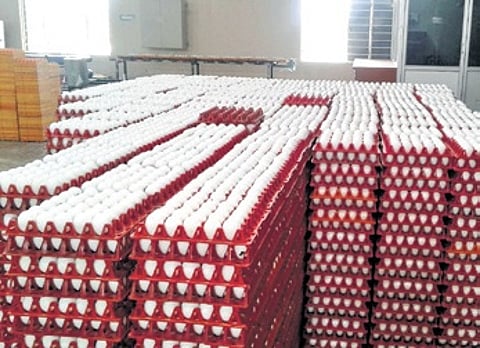
Despite the fall in rates, egg production continues, leading to accumulation of stocks. Producers are storing surplus eggs in cold storage facilities, where they can be preserved for up to three months. Some excess produce is being processed into egg powder, which has a shelf life of three to four months, and is mainly exported to countries where fresh eggs are not easily available. India currently has a few egg powder plants, including facilities in Namakkal, Mumbai and Malur in Kolar district. The Malur plant alone processes about 12 lakh eggs daily.
However, Sheshanarayan noted that export of egg powder has also slowed temporarily due to the ongoing international situation. He added that seasonal price fluctuations typically occur every April, but this year the impact has been more prominent because of the disruption in overseas markets.
