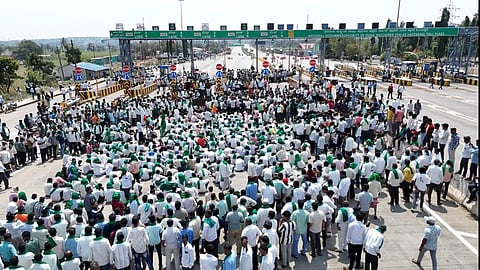

BELAGAVI: Karnataka’s sugarcane crisis has reached boiling point, with mounting farmer unrest threatening to spill over into a wider agitation. Cane farmers have stepped up protests demanding remunerative prices, a state-specific support package and an end to deductions they allege are eating into their earnings.
With demonstrations spreading across North Karnataka, the dispute has exposed longstanding tensions between sugarcane growers, sugar factories and governments over distribution of the industry’s revenues.
The agitation has been particularly intense in Belagavi district, one of Karnataka’s major sugarcane-growing regions. Over the past few weeks, farmers have staged protests at major toll plazas and highways, organised demonstrations at public squares and threatened to intensify their agitation if their demands are not met.
The protests have also drawn the participation of farmer organisations, lawyers and social activists, turning the sugarcane price dispute into a wider political and economic issue.
The immediate demand is a remunerative price of Rs 5,500 per tonne. Farmer leaders are also seeking an additional State Advised Price (SAP) of Rs 1,000 per tonne over and above the Centre’s FRP. They argue that the statutory FRP alone does not adequately compensate growers for the rising costs of cultivation, including fertilisers, labour, irrigation, harvesting and transportation.
Farmers are also demanding that sugar recovery be calculated transparently, rather than relying solely on factory-wide average recovery rates, which they contend can disadvantage growers. They want deductions towards transportation and other charges from sugarcane bills stopped or properly regulated.
Their broader demands include a review of agricultural loans and measures to prevent delays and discrepancies in payments. The agitation has continued despite negotiations with farmer leaders and representatives, and appeals for a settlement. Farmer leaders have warned that they could expand the protests into a statewide bandh if the government fails to deliver a decision.
The state government has maintained that the issue requires discussions involving farmers, sugar factory owners and officials. The government’s position is complicated by the fact that the FRP is fixed by the Centre, while the state’s role in determining any additional assistance or price arrangement involves financial, legal and administrative considerations. The state government must also consider the viability of sugar factories, which contend that higher cane prices have to be matched by sugar realisations and revenues from by-products.
However, farmers argue that discussions and assurances cannot substitute for a time-bound decision. They want the government to announce a clear price and ensure that mills pay growers without arbitrary deductions. The central government, meanwhile, has a direct role in determining FRP and related sugar-sector policies.
A defining feature of Karnataka’s sugar economy is the close relationship between the industry and politics. Several sugar factories and cooperative sugar institutions are controlled, managed or influenced by politicians, elected representatives and their business or cooperative networks.
In several parts of North Karnataka, sugar factories are not merely industrial establishments; they are also major employers, purchasers of agricultural produce and influential institutions in rural life.
Politicians associated with sugar factories cut across party lines. Their involvement in the industry gives them considerable influence over local economic networks, while their political positions provide access to decision-makers on agricultural and industrial policy.
Some elected representatives have also publicly participated in discussions on cane prices and the problems faced by growers. This overlap creates a persistent question of accountability that how can farmers secure a fair price when factory managements and political leadership are closely interconnected? The relationship does not, by itself, establish wrongdoing or prove that every factory owner opposes farmers.
However, it underlines the need for transparent price calculations, independently verifiable recovery data, timely payments and effective regulation of deductions.
The ongoing agitation of cane growers has become a test of whether the state can bring farmers and factory owners to a settlement that is both financially workable and fair to growers. A durable solution would require transparent accounting of sugar recovery, scrutiny of deductions, timely settlement of cane bills and a clear framework for any additional state support.
For now, farmers are demanding an announcement rather than another round of negotiations. Unless the government, factory managements and farmer organisations iron out their differences, the sugarcane dispute threatens to prolong uncertainty across Karnataka’s sugar belt.
Balanced approach necessary
Senior Supreme Court advocate Mohan Katarki, who is closely observing the cane crisis, says cane price fixation is governed by the Essential Commodities Act, 1955, and Sugarcane (Control) Order, 1966 (amended in 2009). “The Centre fixes the Fair and Remunerative Price (FRP) every year through the Cabinet Committee on Economic Affairs, on the recommendation of the Commission for Agricultural Costs and Prices. It considers cost of production, returns from alternative crops, sugar recovery, realisation from by-products, and reasonable margin for farmers. Over the FRP, states add the State Advised Price, which I understand is Rs 100 at present,” he says.
On the two major demands, many feel that in the present circumstances, sugar at Rs 40-45 per kg and cane at Rs 4,600-4,800 per tonne would be reasonable, to absorb rising harvesting and transport costs while protecting the viability of sugar mills.
“The interests of farmers are paramount. I hope the Union government takes a favourable decision soon,” he adds.
Disputes over recovery calculations, harvesting and transport deductions
Karnataka currently has 81 operational sugar factories, including cooperative mills, according to recent industry reports. Belagavi district accounts for 29 factories, the highest in the state.
According to sources, Karnataka’s sugar factories crushed roughly 501.86 lakh metric tonnes (50.19 million tonnes) of sugarcane during the 2024-25 sugar season. For the 2025-26 season, the state government reported on February 25, 2026, that factories had crushed 521 lakh metric tonnes, with total crushing expected to reach around 600 lakh metric tonnes (6 crore tonnes) by the end of the season.
Maharashtra’s thriving sugar industry generally benefits from higher sugar recovery rates, which enable mills to extract more sugar from each tonne of cane and potentially offer better prices. Competition among mills and differences in crushing efficiency also influence payments to farmers.
In Karnataka, particularly Belagavi, the current crisis stems from the gap between farmers’ demand for Rs 5,500 per tonne and mills’ offers along with disputes over recovery calculations, harvesting and transport deductions.
However, Maharashtra is not free from the crisis. Farmers there have also protested over cane prices and delayed crushing. The difference is in the intensity and nature of the current disputes, not the absence of problems, cane growers say.
Karnataka Rajya Raitha Sangha president Chunappa Pujari, who is leading the agitation in North Karnataka, argues that sugarcane farmers are not receiving returns proportionate to rising production costs and sugar prices. Pujari criticised repeated government meetings that produced no concrete decisions, insisting that the agitation will continue until the Centre addresses farmers’ demands.
Farmers gear up for bigger protest
Sugarcane farmers have threatened to call a statewide bandh if the government fails to announce a price of Rs 5,500 per tonne of sugarcane at the meeting convened by CM DK Shivakumar in Belagavi on Monday.
Shashikant Guruji, one of those leading the cane protests, said an agitation would begin at Guralapur, near Belagavi, from 10am Sunday to demonstrate farmers’ unity ahead of the crucial meeting with the CM, who has said the crisis could be resolved through talks. The CM had visited Kittur, where a large number of cane growers were on protest last week.
