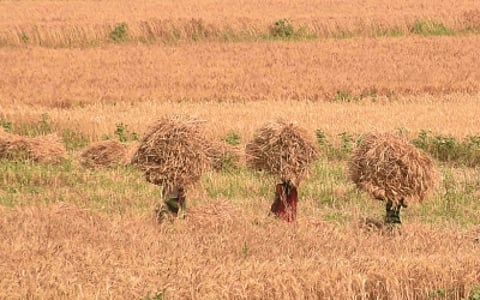

It’s a peculiar situation. The state government’s intent to help farmers is appreciable, and Rs 1,250 crore is a substantial amount for a cash-strapped administration. Yet, the decision to provide an input subsidy of Rs 2,500 each to farmers in distress due to severe drought appears to have missed the mark by a mile.
After four days of a special session on the prevailing drought and the Centre’s 7th draft notification on Ecologically Sensitive Areas (ESA) in the Western Ghats, the government announced its decision to provide input subsidy.
“Farmers are in distress today. While awaiting assistance from the National Disaster Response Fund (NDRF), we have decided to provide an input subsidy of Rs 2,500 to each farmer. We will provide Rs 1250 crore to our farmers in the first phase itself. This is not a small amount. An estimated 45 to 50 lakh farmers will benefit from it,” Deputy Chief Minister and Revenue Minister Dr G Parameshwara announced in the state Assembly earlier this week.
Given the financial constraints facing the government – as re-emphasised in the Finance Department’s note to the Chief Minister’s Office – the allocation is no small amount. However, Rs 2,500 for an individual farmer is not substantive. With crops withering due to dry spells, farmers are in financial distress and risk finding themselves in a debt trap.
The opposition termed the government’s announcement an insult, while the farmers’ association compared it to rubbing salt in the wounds. Expressing resentment, Kuruburu Shantakumar, President of the Federation of Karnataka Farmers Associations, threatened to burn Rs 2,500 cheques outside Deputy Commissioners’ offices. He was among those demanding a loan waiver, compensation of Rs 25,000 per acre, and revision of the NDRF and SDRF norms.
Gundappa S Dulagonda, a progressive farmer from Pattan, around 18 km from Kalaburagi, echoes the community’s view that the input subsidy is insufficient, calling for long-term measures to strengthen the rural economy. He suggests a tank in every village, decent roads, warehouses for agricultural produce, 12-hour power for irrigation pump sets, and a better price for milk procured from them.
Gundappa proudly claims he was not impacted by drought as he converted his three-and-a-half acres into irrigated land by digging a well and diversifying into agriculture, horticulture, and dairy farming. But the number of such farmers in the state remains minuscule.
Farmers’ contention is simple: The government spends over Rs 50,000 crore every year on guarantee schemes and announced big infrastructure projects. It has taken up Bharat Jodo Yuva Sanghas, an initiative to boost youth leadership, sports and social harmony with an approved outlay of Rs 1,010 crore. Yet, why does it continue to treat the agriculture sector unfairly? They feel the outcome of the special discussion on drought fell quite short of their expectations. The agriculture department does not appear to be a priority for the government.
During the session, legislators across parties engaged in a meaningful discussion on the Centre’s 7th draft notification on Ecologically Sensitive Areas (ESA) in the Western Ghats, based on the Dr K Kasturirangan Report. They passed a resolution rejecting it in its present form and seeking time to complete a comprehensive ground-level survey.
Even on drought, many members highlighted their concerns and recommended measures to be undertaken. Still, party politics takes precedence over farmers’ concerns, with the opposition BJP blaming the state government for failing to take early measures. The Congress, in turn, lobbed the ball in the Union Government’s court.
Once the drought is declared, the process of Central assistance to the state should be automatically activated without delay, says Dr TN Prakash Kammardi, former Chairman of the Karnataka Agricultural Prices Commission. He also suggests that the government departments and agricultural universities need to work together to prepare farmers for climate variations and other uncertainties.
While an Inter-Ministerial Central team is expected to visit the state soon to study the situation, the State Government estimates that loss caused by drought is likely to exceed Rs 40,000 crore. The government says the revised relief amount would depend on how the Centre assists the State.
The state government is facing financial hardships. The Finance Department’s advisory, which cautioned the government against excessive spending, underscored the government’s predicament. It highlighted the cash crunch faced by many departments, impacting salary disbursement. Even Transport Minister Byrathi Suresh admitted in the Legislative Council that the state-owned road transport corporations are suffering an annual loss of Rs 8,000 crore, with insufficient funds to pay employees’ salaries.
The welfare programmes announced by the Siddaramaiah government require continued allocation of a significant chunk of the budget. Mobilizing resources for other initiatives has been a major challenge for Chief Minister DK Shivakumar, who seems to be making all efforts to burnish his report card before the 2028 assembly polls.
The immediate challenge would be to provide substantive relief. The Congress and BJP-JDS must set aside their political differences to support farmers before the situation worsens.
