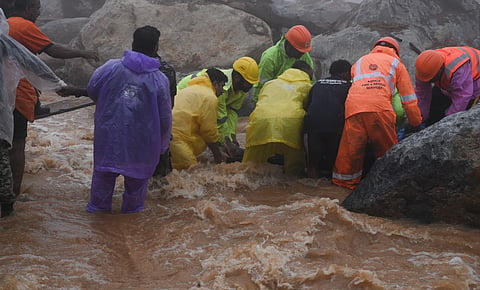

THIRUVANANTHAPURAM : An advanced early warning system for natural disasters, installed by the Geological Survey of India (GSI) in Wayanad around 10 days ago, could not help the district mitigate the losses from Tuesday’s landslide, its worst and most deadly natural disaster.
The system, which utilises artificial intelligence to predict landslides, was introduced to address Wayanad’s high vulnerability to such events. However, it failed to foresee the devastating landslide that struck Mundakkai, due to ongoing refinements and accuracy improvements.
“We could not predict the landslide in Mundakkai as we are still streamlining the automated system. It requires some more work to improve the accuracy of prediction,” said an officer with the GSI.
Union Minister of Coal and Mines G Kishan Reddy had inaugurated the National Landslide Forecasting Centre (NLFC) at GSI HQ in Kolkata on July 19, along with the unit in Wayanad.
The NLFC, aimed at landslide hazard mitigation, is expected to provide early information to local administration and communities, update landslide inventories, and integrate real-time rainfall and slope instability data. The Western Ghats and Himalayan region are considered landslide-prone. In Kerala, GSI’s focus is on Wayanad and Idukki, two of the most landslide-prone districts. Meanwhile, even when the GSI, the nodal agency for landslide studies in India, is fine-tuning its early warning system, the upper regions of Mundakkai have always been on its list of most-vulnerable locations for landslides, with the region having seen minor but consistent landslides since 2018.
“We conducted multiple surveys and marked the region as a highly potential landslide-prone area in the National Landslide Susceptibility Mapping,” said the officer. GSI has termed the latest landslide a disastrous one that has changed the course of the river. The GSI has already started post-disaster studies in the region.
