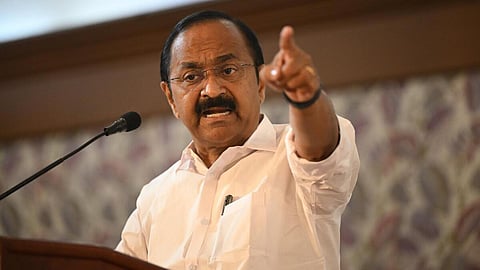

THIRUVANANTHAPURAM: The state government has said it is unable to fulfil the fifth demand of the striking LPST rank holders to reduce the prescribed pupil-teacher ratio from 1:30 to 1:25. Chief Minister V D Satheesan on Wednesday maintained that the average ratio in government lower primary schools is already 1:19 and lowering it further was impractical.
Addressing a post-cabinet news briefing, Satheesan said a committee headed by the Chief Secretary would examine recruitment by the Public Service Commission against non-existent vacancies across departments.
Satheesan said the government was willing to hold further discussions with the LPST representatives to explain its position and resolve the impasse. "The government accepted four of the five demands despite the financial implications and was ready to issue orders on them once an understanding was reached and the agitation was withdrawn," he said.
Explaining the government’s position on the pupil-teacher ratio, Satheesan said government lower primary schools had 3.49 lakh students and 18,856 teachers, taking the average ratio to 1:19 against the prescribed norm of 1:30. Malappuram had the highest ratio at 1:25, while it was 1:11 in Pathanamthitta and Kottayam, 1:12 in Idukki and 1:14 in Kannur, he said.
Changing the prescribed norm to 1:25 would not result in additional appointments, as the existing teacher strength was already sufficient in relation to student enrolment, the chief minister argued.
He also pointed to declining enrolment in schools, seeking a comparison on the number of students in Class I with that in Class X.
On the PSC recruitment issue, Satheesan said the commission was publishing rank lists against vacancies that did not actually exist, creating unrealistic expectations among candidates.
"The proposed committee would examine the practice across departments and recommend corrective measures. The government would also consult the PSC and consider necessary amendments to put in place a system to prevent such recruitment exercises," he said.
He said rank lists sometimes contained thousands of candidates even when the number of actual vacancies was limited. This left candidates, including those placed high on the lists, waiting for appointments that might never materialise.
The government had extended existing rank lists by six months after assuming office, as recruitment had been affected during the election period. However, the extension had also delayed opportunities for candidates on subsequent lists, highlighting the need for a more systematic approach, he said.
Satheesan declined to be drawn into questions on alleged disunity and differences within the UDF and the Congress organisation. Asked about criticism that UDF meetings were not being convened regularly and that collective consultations were lacking, he said he had not heard such criticism.
He maintained that the leadership had only sought an early resolution of the issues and said he would speak to everyone at the appropriate time. On other organisational matters, he asked the media to direct questions to the KPCC president.
On the ongoing agitation by students at Sree Sankaracharya University of Sanskrit, Kalady, Satheesan said the government had no role in the university’s decision to appeal against the High Court order concerning the suspended students.
He said the university, being an autonomous institution, was entitled to pursue legal remedies. "The government had no objection to implementing the court’s directions and was keen to ensure that the students’ academic future was not affected," he said.
