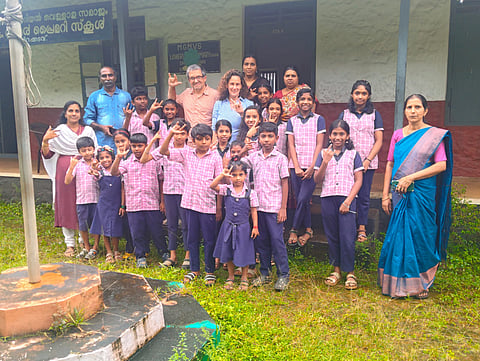

PATHANAMTHITTA: A village, its schools, a library that began in a modest shop room under the glow of a kerosene lamp, a centuries-old temple, and a traditional Onam feast served on a banana leaf -- Chirakkadavu in Kottayam offered two visiting professors from the United States a glimpse of Kerala, off the usual tourist trail.
Dr Sarah Hurwitz and Dr Adam Maltese of Indiana University, USA, visited the village as part of an effort to understand Kerala's rural life, educational practices, traditions and community institutions.
It was their first visit to Kerala, and the day unfolded as an immersive journey through the everyday life and heritage of the village. Notably, the village is the birthplace of freedom fighter Akkamma Cheriyan, adding a significant historical dimension to the rural landscape.
The professors, accompanied by Malayali friends and a group that included researchers Dr Srihari Ravindranath and Dr Amit, who have worked on implementing the Happiness Curriculum in Delhi, Jharkhand and other States, visited Government LP School, Chirakkadavu, MGM UP School, the Jyothi Public Library and the Chirakkadavu Mahadeva Temple.
At the schools, interactions with teachers and children offered the visitors an opportunity to see rural education at close quarters. Cultural programmes presented by the students turned into one of the most memorable moments of the visit, with the professors finding the performances a novel experience.
For the children too, meeting educators from an American university was an unusual and inspiring experience. "They wanted to know about our ways of life, customs, traditions and listened with keen interest," said PG Binu, a teacher,who accompanied the visitors.
The journey through Chirakkadavu also took them to institutions that carry decades of the village's history.
The Government LP School, established in 1881, introduced the visitors to one of the village's oldest educational traditions. The MGM UP School, established in 1956, offered another chapter in Chirakkadavu's educational journey.
At the Jyothi Public Library, the professors encountered a different kind of community story. Founded in 1968 by a group of ordinary farmers in a small shop room with little more than the light of a kerosene lamp, the library has grown into an enduring symbol of the village's reading culture and collective spirit.
Vice-president C.G. Sunil Kumar and librarian S. Lal presented the visitors with a memento.
Discussions at the library went beyond books and reading. The visitors learnt about the role of sacred groves, or 'sarpa kavukal', in nature conservation and about the possibilities of promoting organic farming through the conservation of indigenous cattle.
The visit to the Chirakkadavu Mahadeva Temple added another layer to their understanding of the village's cultural landscape. They learnt about the temple's history, traditions and festivals.
The day ended around a traditional Kerala dining table.
At the residence of P.G. Binu, Binu's mother Gaurikutty, along with family friends, prepared a sumptuous Onam feast for the visitors.
Served traditionally on banana leaves, the meal included rice, dal, pappad and an array of Kerala dishes, with ada pradhaman as a final touch.
For professors accustomed to exploring education and communities through an academic lens, the meal became another lesson, this time in hospitality, food and the social traditions that bind a village together.
