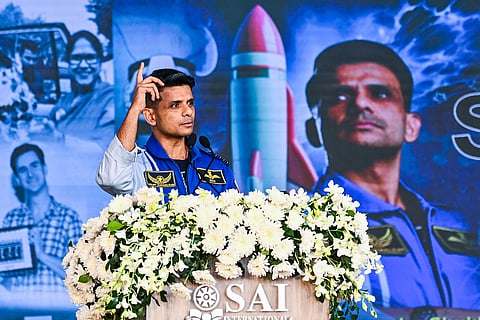

BHUBANESWAR: India is progressing towards conducting its own human spaceflight mission and aims to land an Indian on the Moon by 2040, astronaut Shubhanshu Shukla said here on Wednesday.
Addressing the SAITED event organised by SAI International School, Indian Air Force Group Captain Shukla said the human space mission aligns with the goals of Viksit Bharat 2047 and, once operational, will lift the country’s industries, R&D and several other sectors.
“These missions are going to be extremely complex and students of this generation have a huge role to play in making them happen,” he said. “We want to see an Indian landing on the Moon and we have to make it happen together. So, going forward from this time, I would urge you to be curious and excited about space and science,” astronaut Shukla told the students.
The astronaut selected for India’s first human spaceflight mission Gaganyaan also encouraged students, saying they could choose any profession to be part of future space missions.
"Your chance to be part of a future space exploration isn’t limited to just being an astronaut. There are multiple other domains including nutritionist, designer, space physical educator as well as someone practising space medicine through which you can contribute to the mission,” he said.
Shukla said the country’s rapidly expanding space start-up ecosystem also offers ample opportunities. “Half a decade back, India’s start-ups in the space sector were in double digits, less than 100. Today, more than 300 start-ups are actively working in the field of space,” he said.
Describing his mission to the International Space Station (ISS), astronaut Shukla called it a completely new and powerful experience. “I have been a fighter pilot most of my life. When I went for the mission, I thought that I knew the feeling. But when the nine engines on the Falcon-9 rocket ignited, everything I knew just flew right out of the window. You go from 0 kmph to 28,500 kmph in just 8 and half minutes. This huge acceleration is sustained for a long time and your body feels it. It was such a powerful experience,” he said.
He added that during his 18-day stay at the space centre, he lost about 5 kg of weight, including around 4.2 kg of muscle mass. “That is how quickly you lose your muscle in space because you are not using it,” he said.
Shukla said the initial results of his micro-algae experiment, one of seven research projects he carried out in space, will soon be published by scientists.
“Micro-algae are a very good source and take very little space to be grown. I grew them in space for 18 days. The initial results will be published by the scientists very soon and if they are found viable, they can really be a very good source of addressing food security not just in space but on the ground as well,” he said.
"But when the nine engines on the Falcon-9 rocket ignited, everything I knew just flew right out of the window. You go from 0 kmph to 28,500 kmph in just 8 and half minutes. It was such a powerful experience" said Shubhanshu Shukla.
