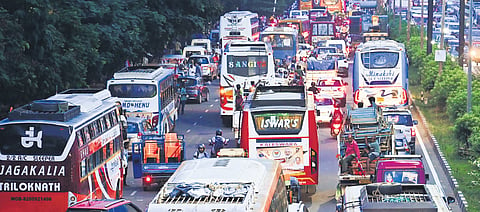

BHUBANESWAR: The tragic bus fire near Kurnool in Andhra Pradesh that left 20 dead has exposed the vulnerability of long-distance luxury buses and blatant safety violations that plague the travel and transportation sector.
This was the second such mishap within a week after a similar incident in Rajasthan that killed 27 passengers when an air-conditioned (AC) sleeper bus travelling from Jaisalmer to Jodhpur caught fire. Both incidents involved air-conditioned sleeper coaches packed with passengers and took place during the early hours when most travellers were asleep.
These frequent fire tragedies involving luxury buses have turned the spotlight on the safety measures adopted by the bus operators and enforcement protocols put in place by the authorities in Odisha and elsewhere.
An investigation revealed a troubling reality as most of the buses plying on Odisha’s roads remain dangerously unprepared to deal with fire emergencies. From design to lax enforcement, the passenger carriers continue to rely on luck rather than safety measures to save lives.
As per the data obtained from the Commerce and Transport department, 16,090 buses having seating arrangements for 25 and above passengers have been registered in the state between January 1, 2005 and September 30 this year. Among them, 142 are school buses, 729 are government buses and the remaining 15,219 buses are owned by individuals and private firms.
Of the 729 government buses, 465 belong to Odisha State Road Transport Corporation (OSRTC) and 138 among them are AC buses. The figures, however, exclude the new fleet of around 1,745 conventional diesel buses compliant with BS-VI emission norms that were under procurement recently by the OSRTC.

The department does not have specific data on the category of private buses plying in the state. But as per private bus operators’ association, the number of AC buses, AC deluxe and Volvo buses would be more than 8,000. It’s basic fire-safety design or operational standards of these buses that remain questionable.
Compliance matters
According to insiders, there is no clarity on the number of buses which are fully fire compliant. As per the Central Motor Vehicles Rules (CMVR) and Automotive Industry Standards (AIS) framework set by the Ministry of Road Transport and Highways (MoRTH), all passenger buses must adhere to stringent fire and design codes.
Crucial among them are AIS-052 and AIS-135. While AIS-052 mandates emergency exits, hammers to break safety glass and fire-retardant materials in interiors, AIS-135 prescribes installation of fire detection and alarm systems (FDAS), fire detection and suppression system (FDSS) and fire alarm and protection system (FAPS) in passenger buses.
The rules mandating certain fire safety provisions notwithstanding, operators flout norms as enforcement remains weak. Many long-distance and sleeper coaches are fitted with flammable interiors, synthetic upholstery and substandard electrical wiring that help fire to spread immediately. In many buses, emergency exits are either absent, obstructed or difficult to operate.
In many buses, emergency exit signage remains invisible. Similarly, window-escape hatches are found screw-locked, welded or jammed. Rear service doors where present, are mostly locked or obstructed. Many luxury buses carry fire extinguishers as a token compliance measure to pass inspection but fall short of critical safety requirements like functioning emergency exits, crew training and periodic maintenance.
The biggest problem is during fire incidents, bus staff (driver, helper and conductor) are the first to abandon the scene in panic, leaving passengers locked in. Driver of a long-route bus admitted they had never received formal training in emergency evacuation or extinguisher use. “The extinguishers have been kept because the officials ask for them. Nobody shows us how to use it. When there is fire, everyone just runs to save their lives,” he said.
These buses, nonetheless, get fitness certificates and route permits from local transport authorities, raising questions about enforcement and oversight. Road safety expert and lawyer Subrat Nanda said safety compliance in many buses, be it government-owned or private, is reduced to paperwork rather than a real-life safeguard.
“The law is crystal clear. A bus must have one entry, one exit and one emergency door, besides a roof hatch and two functional extinguishers - 6 kg and 4 kg. But the design compliance ends once the fitness certificate is issued. There is absolutely no enforcement,” he said.
While fully built buses manufactured by OEMs like Tata Motors and Ashok Leyland usually meet AIS standards, most private operators buy only the chassis and get the body built at workshops. Those builders often skip fire-resistant insulation, emergency exit frames or even basic escape windows.
People involved in bus body manufacturing point at cost pressures pushing small operators to trade safety with better operational returns. “If we follow AIS norms strictly, the cost of one bus goes up by at least Rs 5 lakh more. Small owners cannot afford that. They want more seats, not more exits. Many long-distance buses have their rear emergency doors converted into luggage racks,” he said.
Bus operators and body manufacturers, however, claim that the buses registered after 2020 are all fire safety compliant. “We are authorised to make the bus body as per the AIS frameworks. We follow all the provisions mentioned in the code and use the materials as specified. If the materials used in bus bodies are highly inflammable, the government should modify the body code accordingly,” said Pritam Tripathy, proprietor of Maa Automotive at Jagatpur in Cuttack.
General secretary of private bus operators’ association, Debendra Sahoo said after the body is manufactured, it is sent for inspection by a Pune-based government agency and the bus gets registered only if the inspection report is okay. The fitness is also checked every year. He, however, admitted that most bus staff might not be trained to operate the extinguishers. “We will soon arrange an awareness programme among bus operators to train staff and introduce announcements about the facilities available in buses to use during emergencies,” he added.
Enforcement, a weak link
Regional transport officers (RTOs) are supposed to ensure that each vehicle’s body design conforms to approved drawings under the bus body code before issuing a fitness certificate. But inspections are largely perfunctory because the number of buses to inspect is sometimes too large. Even as many intercity and private stage-carriages in Odisha lack properly configured emergency doors or have exits blocked by luggage or modified seating, these vehicles continue to operate.
Sources said in many cases the transport officials depend on the documents submitted by the bus body builders. Most of the checks focus on roadworthiness, engine, lights and brakes. Fire safety is rarely verified in detail.
The State Transport Authority (STA) maintained that all buses are required to meet AIS standards before fitness certificates are issued and renewed. But insiders said the process is easy to manipulate. “If an operator brings a certificate from an accredited body builder, we take it on face value,” he said.
The STA has also issued instructions directing RTOs to strictly enforce fire-safety rules and carry out inspections, at least for school buses. They have been asked to ensure fire detection and suppression systems and warned of action against violators. But those directives appear to have been unevenly implemented.
Nanda said bus safety framework needs an overhaul. Fire detection sensors, automatic extinguishers and illuminated escape paths should be made mandatory. “Transport officials, not just private operators, must be held accountable. If a bus catches fire, the responsibility doesn’t end with the driver or the bus operator. It must extend to every officer who stamped its fitness papers,” he said.
Transport commissioner Amitabh Thakur said the provision for FDAS and FDSS has been made mandatory for school buses manufactured on or after April 1, 2019 and April 1, 2020 respectively. In addition to school buses, the provision for FDAS, FDSS and FAPS has also been made mandatory for all fully built Type-III buses of category M-3 manufactured on and after April 1, 2019 and October 1, 2023 respectively.
“Non-provision of the above equipment with the vehicles manufactured on and after the prescribed date is a clear violation of statutory provision. MVIs have been asked to ensure that the mandatory systems are in place with the vehicles in the prescribed manner. RTOs have been instructed to conduct random inspections. Responsibility will be fixed if any deviation is noticed,” he said.