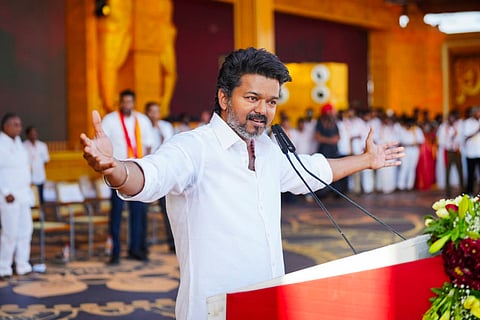

Actor-politician Vijay used his party’s second state-level conference at Parapathi in Madurai district on Thursday to launch a sharp political offensive, positioning TVK as an alternative force while attacking all three major players in Tamil Nadu politics, the BJP, DMK and AIADMK.
"There will be no alliance," he reiterated, underscoring that the 2026 election in Tamil Nadu will be between the DMK and the Tamilaga Vettri Kazhagam.
The TVK leader framed the BJP as his party’s ideological adversary, accusing it of neglecting Tamil Nadu’s interests and aligning with the RSS for appeasement. He invoked issues ranging from the arrest of Tamil Nadu fishermen and the demand for Katchatheevu’s return to opposition against NEET, suggesting that the Centre was indifferent to the state’s needs. He also alleged discrimination against minorities, warning that Tamils would not attach themselves to the BJP despite its calculations for the 2029 elections.
Vijay also accused the BJP of hiding the findings of Keezhadi.
Vijay saved some of his sharpest words for the DMK government, accusing Chief Minister M K Stalin of betraying women, farmers and fishermen. He dismissed the state’s flagship cash transfer scheme as inadequate and accused Stalin of deceiving vulnerable sections. His repeated reference to the Chief Minister as “uncle” carried challenge, underscoring his intent to position himself against the ruling party’s leadership.
For the first time, he turned his criticism on the AIADMK, questioning its state after MG Ramachandran’s death and hinting at compromises with the BJP whenever its leaders came under central scrutiny. This shift marked a clear break from his earlier avoidance of direct confrontation with the party founded by MGR.
Throughout his address, Vijay leaned heavily on symbolism and imagery to project himself as a singular force in Tamil Nadu politics. Comparing himself to a lion whose roar resonates far and wide, he suggested that TVK was the unstoppable voice of the people, while dismissing critics and sceptics who doubted his political journey from cinema to public life.
A lion is always a lion - the king of the jungle - though there are so many animals like jackals in the forest," he said and added this description was a clear declaration.
He reminded supporters of the resistance he faced at every stage, from doubts about whether he would enter politics at all, to questions over his ability to launch a party, to criticism of his first manaadu. Yet, he portrayed each challenge as fuel for his resolve, presenting TVK as a movement that could not be subdued.
Turning to Madurai’s cultural and political legacy, Vijay evoked the imagery of Jallikattu, the Meenakshi Amman temple and the Vaigai river, while drawing parallels with the late Vijaykanth, who also hailed from the region.
Vijay hinted that political history was poised to repeat itself, predicting that the 2026 elections could mirror the landmark verdicts of 1967, when the DMK first came to power, and 1977, when M G Ramachandran led the AIADMK to a sweeping victory.
Signalling his ambitions, he declared that TVK would contest all 234 constituencies in Tamil Nadu. By casting his candidacy across the entire state, he sought to underline that TVK’s fight was not limited to a few pockets but aimed at statewide transformation.
